ACFC Centerbacks 2025
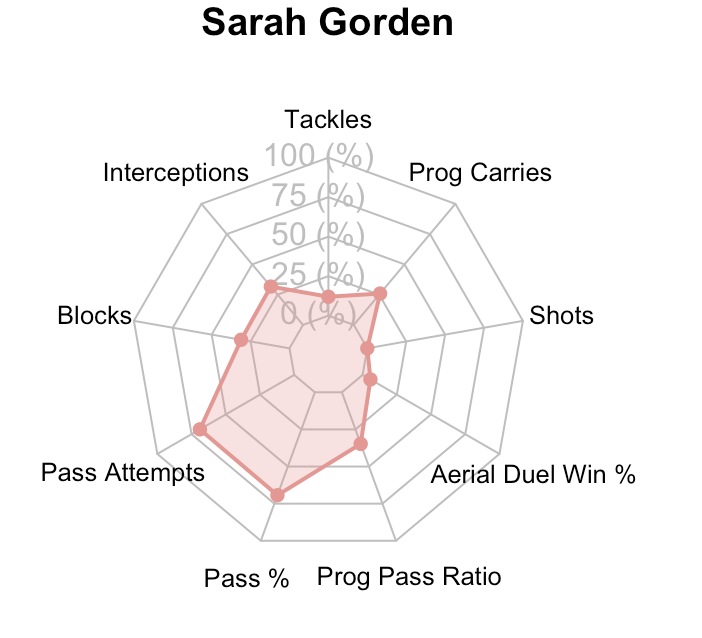
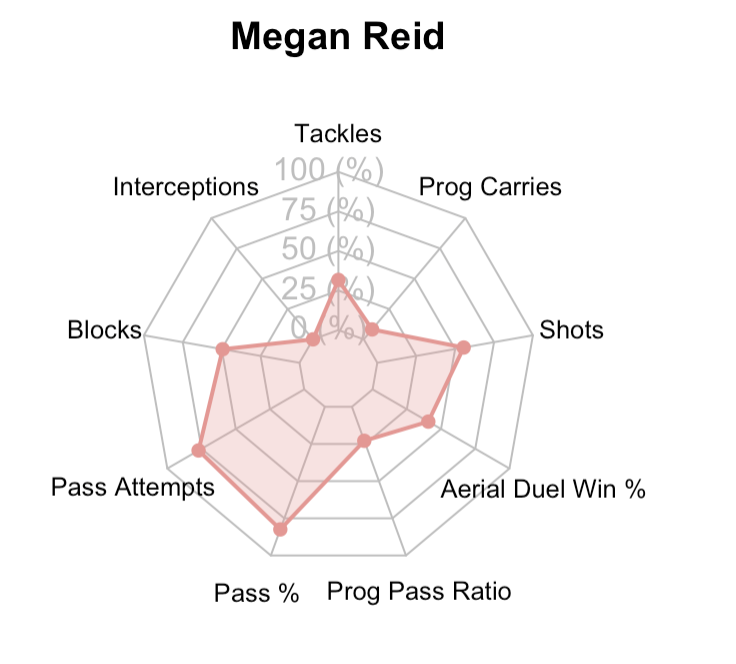
As with the previous article, players will be listed in order of minutes played. Radar plots for all centerbacks include: Tackles, Interceptions, Pass Attempts, Pass Completion Percentage, Blocks, Aerial Duel Win Percentage, Progressive Pass Ratio, Shots, Progressive Carries. Many of these seem straight forward to include, but I’ll explain some that may not be. I’m including Pass Attempts to show the volume of Passing and Pass Completion Percentage to show accuracy. Progressive Pass Ratio takes a player’s Progressive Passing Distance and divides it by Total Distance to get a sense of how vertically they pass. Including Shots may seem a little unfair, especially to ACFC centerbacks, but I believe that a truly world-class centerback will also provide a goal threat. xG reflects accuracy more than Shots, of course, but due to the low numbers that a centerback generates, I feel that Shots better reflect the role, and the volume of the players contribution to scoring chances. And finally, Progressive Carries, because dribbling the ball forward is a different, and helpful, tool for a defender to have. The population for the radar plots are all defenders, excluding those identified as “Creative Fullbacks” or “Attacking Fullbacks.”
Involvement of Centerbacks
I touched on this with the fullbacks, but Angel City centerbacks have never seemed to get a lot of Tackles, regardless of who has been coaching. It still amazes me that the previous year, in 2024, Alyssa Thompson had more Tackles than Sarah Gorden (45 to 30), and even more Tackles in the Defensive Third (22 to 21). But before we start looking at individual players, I wanted to determine how unusual this is. Is this trend true across the whole NWSL? It’s always felt like Angel City had a “Everyone needs to be defending” mentality, but I wanted to get some numbers on that.
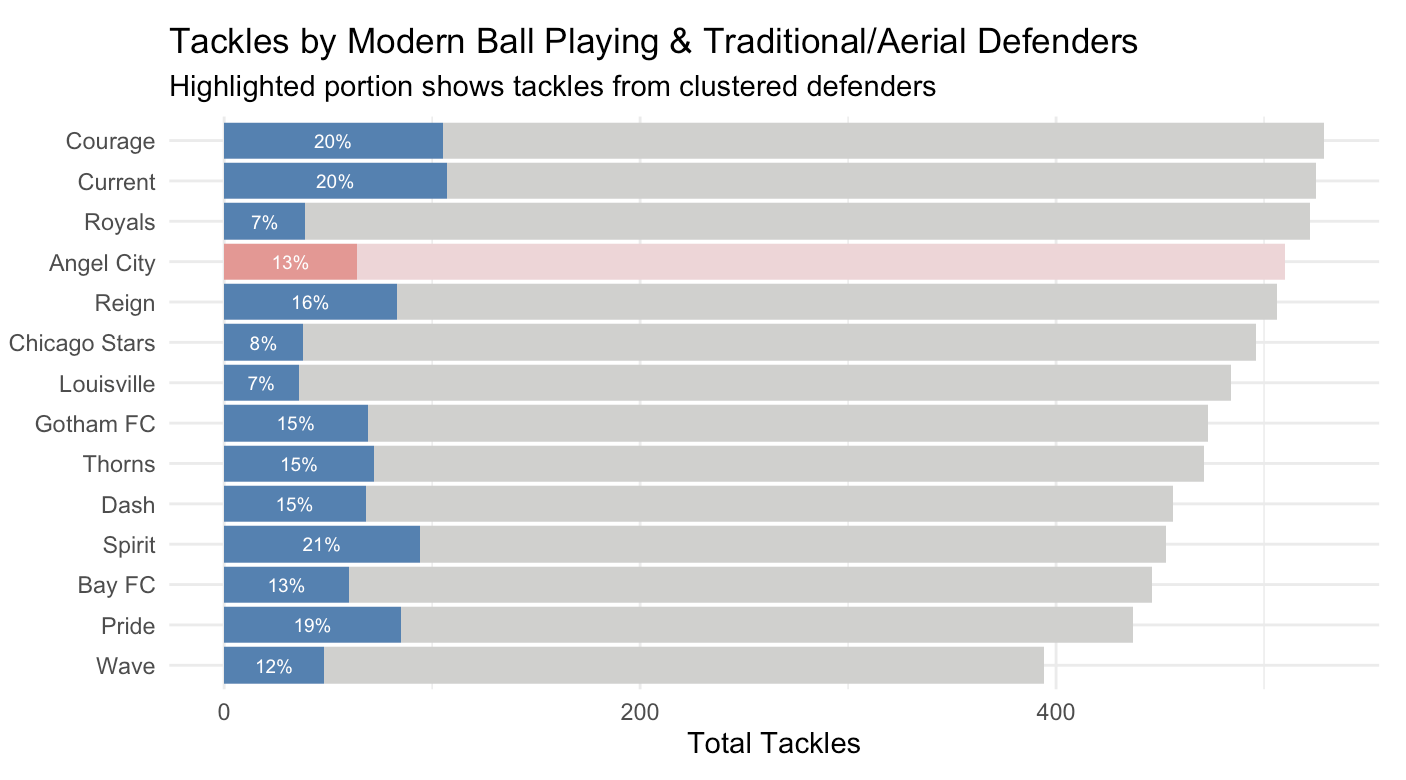
The graph above shows each teams total tackles, and what percentage of those Tackles were done by players I identified as Modern Ball Playing or Traditional/Aerial Defenders. There are some exceptions, but in almost every case, these are the centerbacks. Unfortunately, FB Ref only categorizes players as Defenders, and of course, plenty of players do spend time at both centerback and fullback. So take this with a grain of salt, but it is generally accurate, and regarding Angel City, it is 100% accurate.
We see that 8 teams had higher percentages of Tackles from their Centerbacks than Angel City. There are teams that get less Tackling from their centerbacks, but my perception of the lack of interventions from this position was correct. Angel City is generally treating it as a bad thing if the ball gets all the way through to the centerbacks. Consequently, the defensive stats for these players should be viewed in that context. The larger question is whether coaches have done this because they do not have faith in the centerbacks to make the stops.
We have an easy choice on who to start with, as Captain Sarah Gorden played the most minutes of anyone on Angel City. She had 26 starts from 26 matches for 2,273 minutes, or 97.1% of the available minutes. She played the full 90 in all but 2 matches.
Defense
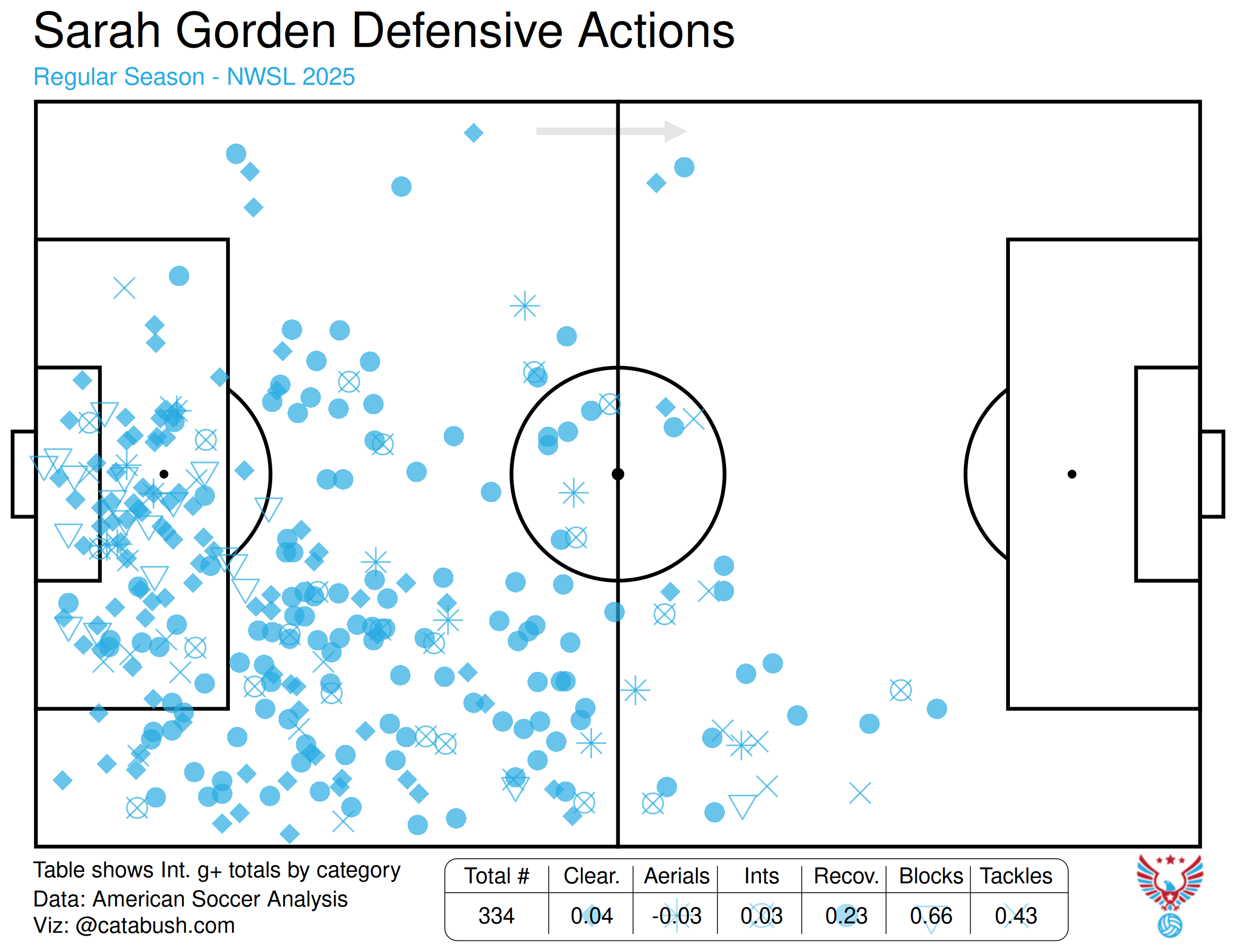
Gorden’s 0.99 Tackles per 90 are in the 22nd percentile among NWSL defenders. She is third amongst the four Angel City centerbacks. This rate is historically in keeping with what Gorden typically has done, however. Of her five seasons in which Tackles were recorded, Gorden has two seasons that were higher, and two that were lower, with an average of 1.05 Tackles per 90, so this can be viewed as a normal season for her. While her actual number of Tackles is low, her success rate is better. Gorden won 66.7% of her challenges, which is in the 58th percentile, while her rate of only 0.28 Challenges Lost per 90 was in the 68th percentile. Interceptions are possibly more of a concern, as her mark of 0.83 this year was a career low, and is the fifth straight year in which her interception rate has gone down. This was, however, still a higher rate than Doorsoun and Reid. Her Block rate of 0.83 was in the 28th percentile overall, and was below her career average of 0.87. Shots Blocked (0.59) was 41st percentile. This does raise a question though, as there were multiple occasions where Gorden would fall back to the goal line, often behind Anderson. This always came across to me as a lack of trust in Anderson’s shot stopping abilities, and I do wonder if this is something that was coached, or instincts on Gorden’s part. I don’t think that it works, though. For one thing, this strategy keeps every attacker is onside. It also often left an attacker unmarked. A future study should be done to determine that success rate, and how many goals were prevented by Gorden, versus how many were conceded by allowing an unmarked attacker to take an uncontested shot. Of course, not all of Gorden’s blocked shots were on the goal line, but even so, 0.59 would be 15.34 Blocked Shots for the whole season. The league average Goals per Shot is 0.098, which means the maximum Gorden is preventing is 1.5 Goals for the season. I am not, in any way, saying that defenders shouldn’t block shots, but I don’t think that there is enough benefit to prioritizing a block over anything else. My opinion is that it is more effective for defenders to mark and let goalkeepers make the stop.
Anyone who has watched Gorden knows that one of her best strengths is her speed. She almost single-handedly negates the possibility that the opposing team can put a ball over the top for an attacker to run on to. So unsurprisingly, her best defensive stat is in Recoveries. Gorden had 4.87 per 90 (84th percentile). However, there is also a note of caution here as well. Gorden had previously never had less the 7.37 Recoveries per 90, which was last season when she was in the 97th percentile. Part of this may be due to the coaching changes, but we should allow for the possibility that Gorden has gone from elite to very good in this regard, and it is something to keep an eye on for the upcoming season.
On the flip side, aerial prowess has never been a hallmark of Gorden’s game, but her 0.43 Aerial Duel Wins per 90 only narrowly surpassed her lowest career mark (0.42), while her 28.2% Win rate for Aerial Duels was a career low (previously 35.7%). I don’t think that anybody has the expectation that Gorden would be dominating on Aerial Duels, but it does emphasize that she needs a partner who does and a goalkeeper that is willing to come out for crosses. An additional aspect to this is that Gorden is usually deployed as the right centerback, whether it’s a back three or a back four, and Gisele Thompson, who is the first choice right back, also does not have an aerial presence. Thompson contested 8 Aerial Duels, and only won 2 of them. So while I consider both Gorden and Thompson to be good players, their combination does create a vulnerability to an opponent with a tall left winger.
One final note on defense: Gorden is very good at not fouling opponents. She only committed 7 Fouls the whole season (0.28 per 90, 91st percentile), and had 2 yellow cards. Additionally, she was able to draw 19 Fouls. Just about any foul committed by a centerback is going to result in a great chance for the opposition from that free kick, while all fouls drawn are going to almost always mean relieving the pressure on the defense. To me, this is a reflection of her intelligent defending, and the veteran leadership we expect from Gorden.
Her g+ score for Interrupting from ASA was -0.22, 40th in the league among centerbacks.
Passing
As we see in the radar plot, Gorden’s passing stats stand out the most for her. This is partly due to my inclusion of all defenders except for attacking fullbacks. Among only centerbacks, Gorden is only in the 39th percentile of Pass Attempts (51.28), and 46th percentile for Total Pass Completion Percentage (83.8%). This is down significantly from the 66.5 Attempts last year, although this is likely due to the change from the possession style that Tweed played (or more likely was told to play by management) and the more direct style under Strauss. Angel City’s total possession went from 53.7% in 2024 down to 50.2% in 2025, and as a team went from 12,809 Total Pass Attempts (4th) down to 10,926 (10th). So it is less surprising to see this decline. The biggest decline was in Short Pass Attempts (22.0 to 13.0), although Medium Pass Attempts also went down (34.9 to 29.0). Long Pass Attempts went down slightly (8.51 to 8.18). Her Pass Completion Percentages were: Short - 91.2%, 71st percentile, Medium - 90.2%, 38th percentile, and Long - 56.5%, 61st percentile. That Medium Pass Completion Percentage is the only one that doesn’t look good, but it is only 0.4% below the league average.
Progressive Passes stand out as Gorden’s highest percentile score of any metric (4.51 per 90, 95th percentile). Because Progressive Passes by definition exclude a pass from the defending 40% of the pitch, 4.51 Progressive Passes is very good. These passes can be seen in the plot below from ASA. And generally, I think that Gorden’s passing does look pretty good. Her xPass score of 38.3 is in the 90th percentile, and reflects that she is completing more passes than might be expected.
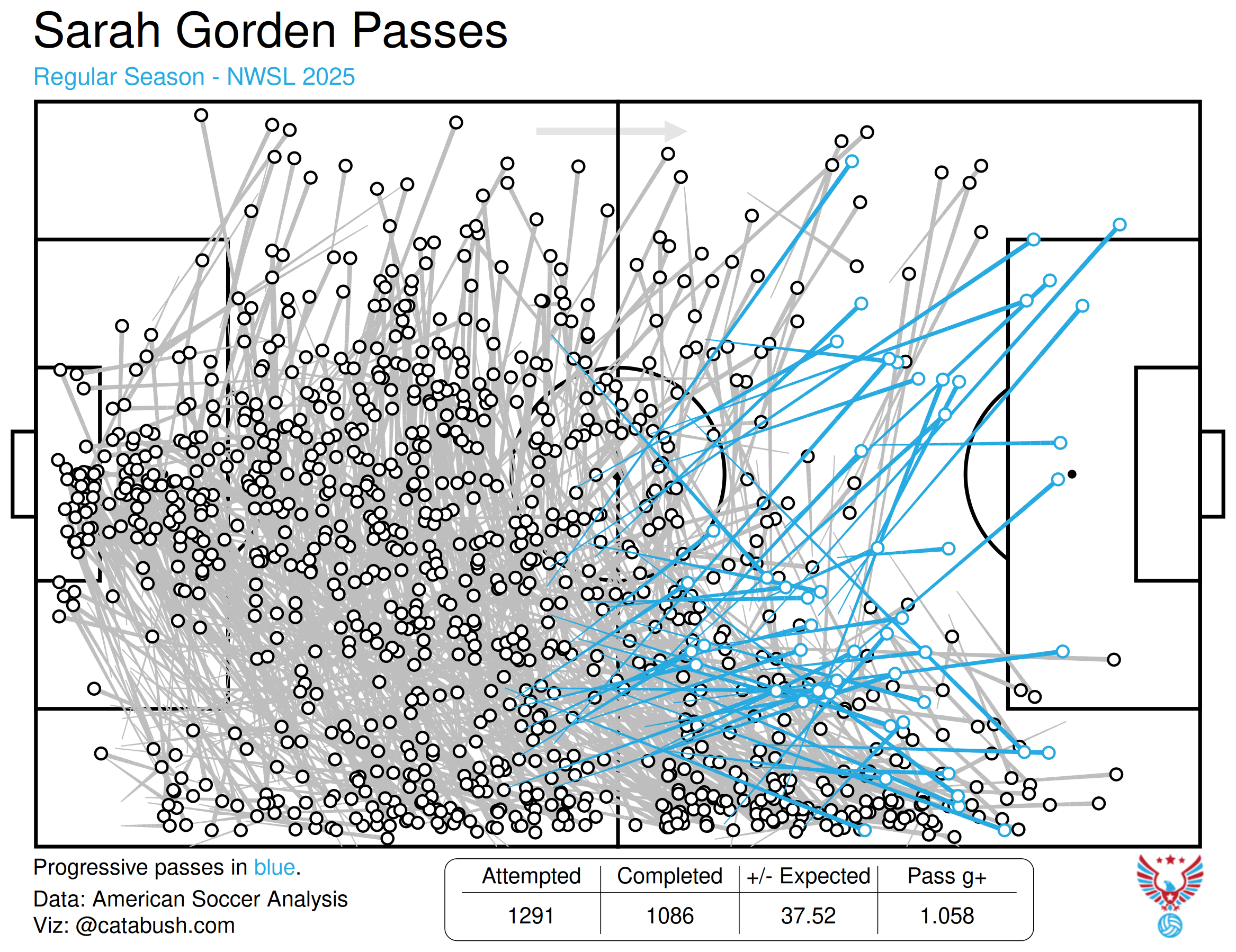
However, the question is how valuable that passing actually is. In order to dig a little bit deeper into it, I divided a player’s Progressive Passing Distance by their overall Passing Distance to create a progressive passing ratio to determine how much of their passing advances towards the opposition goal. 35.95% of Gorden’s passing distance was for Progressive yards, which was only in the 27th percentile of NWSL defenders. ASA takes a slightly different approach, calculating the average vertical distance of all of a player’s passes. In this regard, Gorden had a average of 8.05 vertical yards, which is in the 62nd percentile. Looking at their g+ scores for Passing, Gorden gets a -0.12, which is in the 33rd percentile. To me, the sum of all of this is that Gorden can be considered a tidy passer, but not one that will make things happen. All season I have felt like Angel City has had trouble consistently breaking the first line, and these results support that.
Possession
Gorden had 10.3% of her team’s Touches, which is in the 75th percentile and pretty typical from Angel City centerbacks. with Doorsoun at 10.6% and King at 10.2%. 80.8% of her Touches were in the defensive half, with an average of 2.5 Touches per 90 in the Attacking Third, which is in the 30th percentile. She only has 0.12 Progressive Passes Received, and while nobody expects centerbacks to receive too many of these, she’s still in the 21st percentile. Emily Sams, as an example, is at 1.28. The better metric might be the Receiving portion of ASA’s g+ scores. Gorden has the third lowest score among centerbacks here at -0.34.
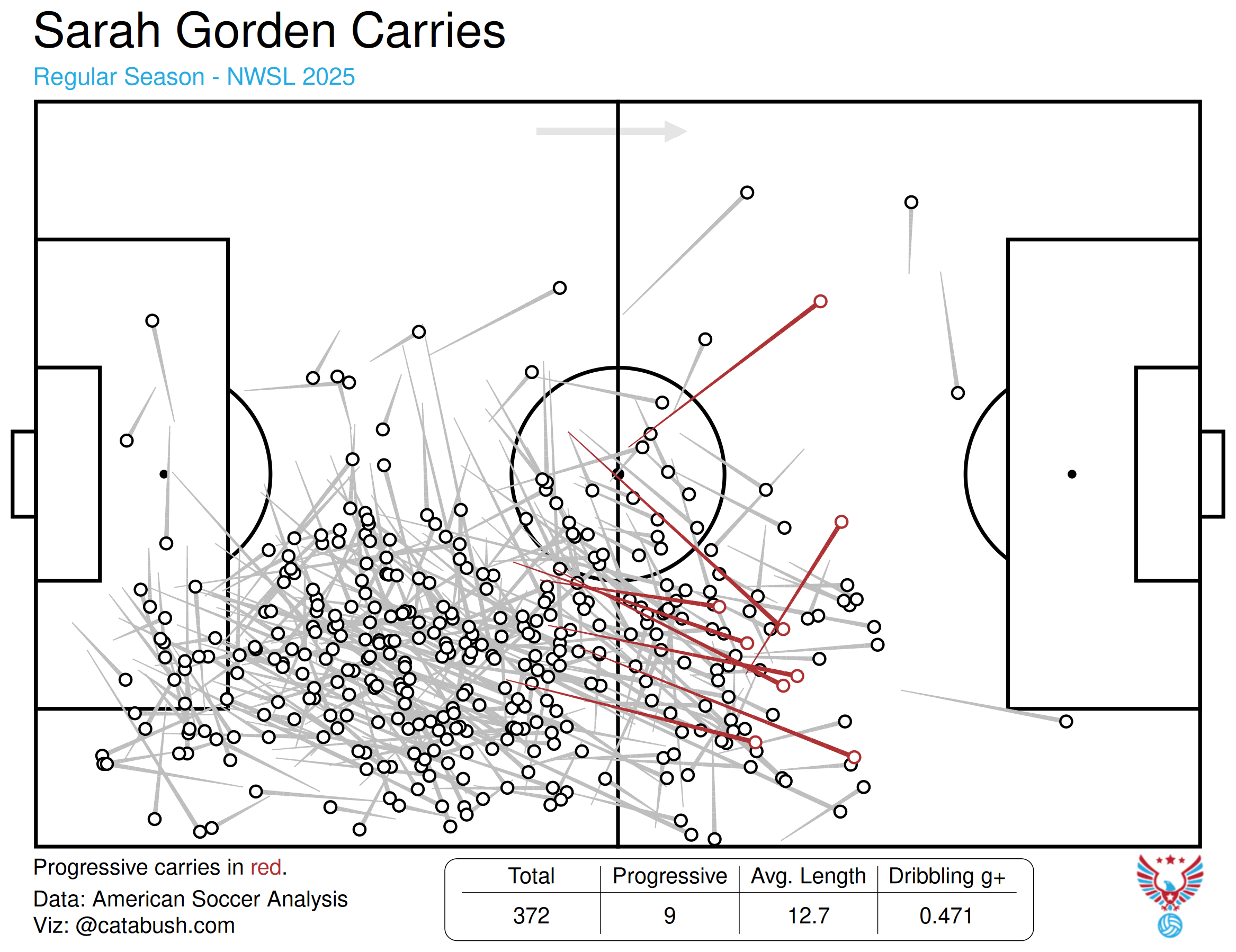
On the flip side, she has the second highest g+ score in dribbling, with 0.45. She averages 34.43 Carries per 90 (66th percentile), but 0.63 Progressive Carries (45th percentile). Her average Carry Distance is 5.70 yards (94th percentile). You can see in the chart below that almost all of her Carries go out to the right, even the ones that are progressive. My question, which this data can’t answer, is whether Gorden is just taking space that the defenders are giving her. Most importantly, is she breaking that first line with these carries? The only clear indicator in the data would be from Take-Ons, in which Gorden averaged 0.36 per 90 (40th percentile). Only one Take-On every three matches suggests to me that Gorden was only advancing into space that the opposition was willing to give-up. My observations also correspond with this. I can often remember seeing Gorden advancing the ball, but never really going on marauding runs that would upset an opposing defensive structure. That consistent advancement does add a lot of value, and if there was more disruption from the midfield or attackers, that can lead to goals. But on it’s own, I don’t think that we see these carries lead to actual goal scoring.
Attacking Contributions
As I stated at the top, goal contributions are not the primary job of a centerback, but I think it is important nonetheless. The best teams find different ways to score, so even 3 goal contributions from a centerback, whether those are long balls pinged over the top or scoring from set pieces, represent a different facet to an attack and multidimensional teams are harder to beat.
Gorden is not the player to deliver this attacking aspect, however. I want to emphasize that this doesn’t mean that she’s not adding to value to set pieces. She is usually kept as the last player back on corner kicks, and honestly, with her speed, I’m not sure that there is anybody else in the league that I would pick to single-handedly try to stop a fast break in the opposite direction. So with that caveat stated, here are Gorden’s offensive numbers.
Gorden had 0 Goals + 0 Assists for, with 2 Shots, 1 On Target. She had 2 Key Passes (0.08 KP per 90, 12th percentile), with an xAG per 90 of 0.012 (29th percentile), an xA 0.02 per 90 (45th percentile), and 0.83 SCAs per 90 (32nd percentile). Despite her 2 Shots, Gorden didn’t register any xG. For her career, Gorden has never had a Goal or an Assist, so this is not unexpected.
Conclusions
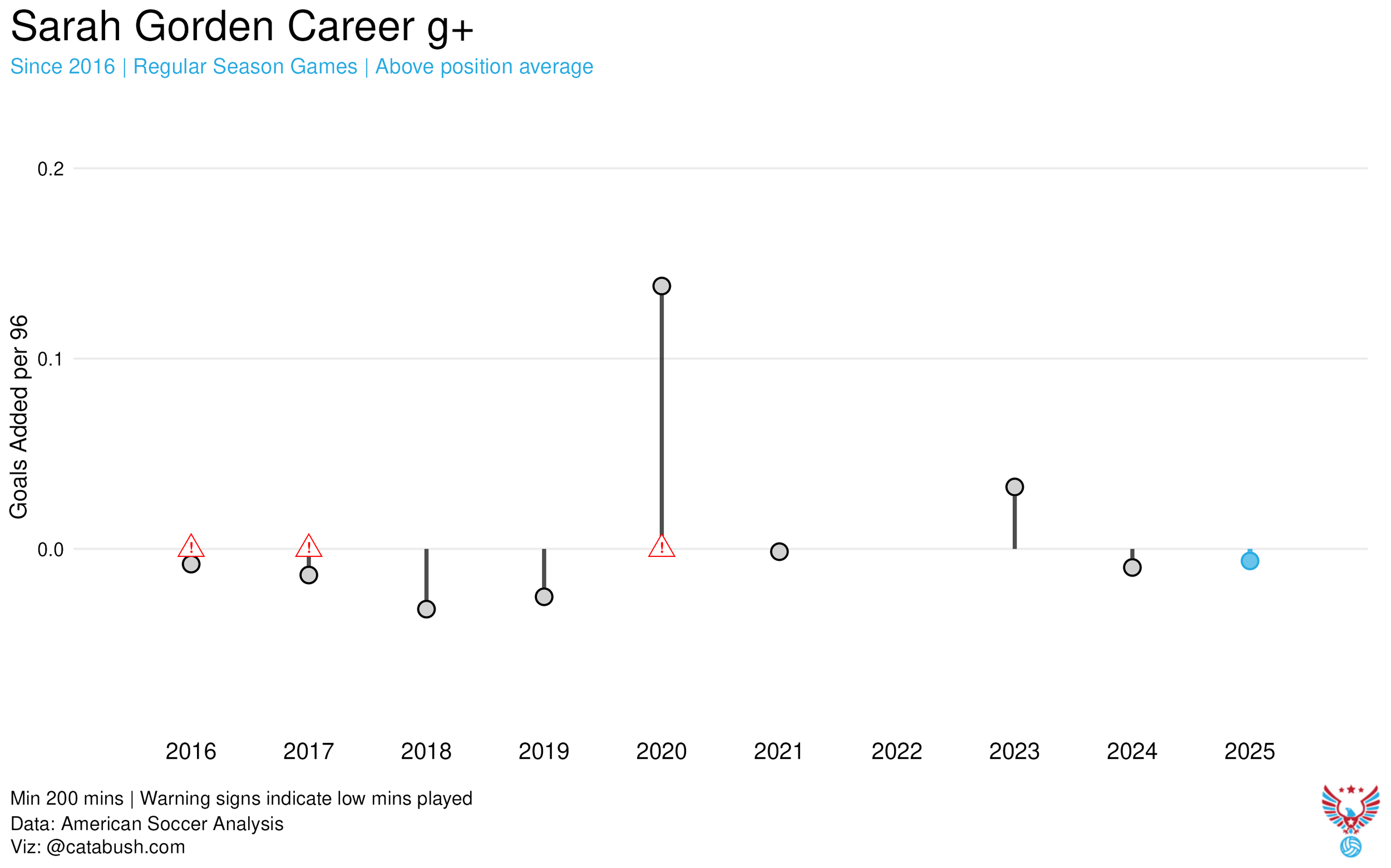
From ASA, Gorden’s overall Goals Added was -0.24, which was in the 46th percentile. She was twice named to the NWSL Best XI, in 2021 and 2023. In 2023 especially, ASA had her as the 2nd best centerback with +1.19. The chart below shows how Gorden has compared to other centerbacks through her career. While I think that her defensive stats aren’t bad, and especially for ACFC centerbacks, she doesn’t stand out as a defender that can be left alone and will successfully smother attacks. Her passing is generally tidy, but not particularly progressive, and certainly not line breaking. She adds a dribbling dimension, but not in a way that is that overly dangerous. Because Gorden doesn’t add anything in terms of aerial duels or goal contributions, in addition to these other observations, I think that we need to downgrade Gorden from elite to good.
Angel City was tied for the 3rd worst defense in the NWSL last year, allowing 41 Goals, while on the opposite side, KC only allowed 13 Goals on the year. Gorden played more than twice as many minutes as any other ACFC centerback, and 97.1% of all available minutes. As a veteran and captain, I think that she does bear some responsibility for this poor defensive record, although certainly not all of it. Ironically, I think that she does take that responsibility to heart, and multiple times there were defensive breakdowns that happened because she was playing what I consider the defensive equivalent of hero-ball. She often tried to make the stop herself, when I think what the team needed was organization. There often seemed to be a lack of communication with Anderson, especially. On the other hand, with centerbacks especially, I think that so much comes down to doing what the coach asks. My impression is that Gorden was always meant to stay as the last line of defense, which meant that even other defenders, like Doorsoun, may have license to step forward and challenge the ball carrier, while Gorden wasn’t given that same freedom.
Gorden is signed for two more years, through the 2027 season, with a mutual option after that, but this upcoming season should prove interesting. Emily Sams also plays right sided centerback. If Straus keeps playing with three centerbacks, there is every reason to think that Gorden will see a lot of minutes. But if Angel City plays a back four, it is possible that Gorden will no longer be an automatic starter when all players are healthy.
Reid had the second most minutes among Angel City centerbacks, which was a little bit of a surprise, as I don’t think that she was ever considered a first choice this year, with King preferred alongside Gorden in the first half and Doorsoun in the second half. Even so, she had 9 starts, 18 appearances, and 896 minutes, which in itself speaks to the importance of squad depth. Reid also had 5 matches as an unused substitute.
Defense
I have always considered defense to be Reid’s forte, and stopping in particular. These stats demonstrate that, as she has high marks in Tackling (1.9 per 90, 75th percentile) and Blocks (1.2 per 90, 65th percentile). In fact, the only reason Reid doesn’t stand out more on the Tackling part of the radar plot is the absolutely insane numbers that Nuria Rábano put up for Utah (5.06 Tackles per 90, only one other player was even above 2.7). One other area that stands out for Reid is Clearances (7.6 per 90), in which she led the league. I’ve always had trouble with including Clearances. I think that there is a time and place when they are necessary, but it’s clearly better to find an outlet pass to a teammate instead, and maintain possession, if possible. I also think that a high rate of clearances as a team is a sign that the defense is under sustained pressure. So I generally don’t include this stat, because I don’t feel like it’s always positive. But any time a player leads the league in a category, it’s worth mentioning.
However, while Reid does well challenging the ball carrier, her Interceptions are very low (0.2 per 90, last among centerbacks). I’ve always viewed Interceptions as a good marker for defensive positioning and reading the play. A defender has to know when it is appropriate to step up into that passing lane. A team’s strategies and coaching are also going to affect this, but as we see from the marks of Gorden and King (0.87 and 1.27 respectively), ACFC centerbacks can do significantly better in this regard. I would posit that the inverse relationship of Reid’s high rate of Clearances and low rate of Interceptions is related. I think that too often she is playing it safe, knocking the ball out of the defensive zone. I would even take this a step further and say that I don’t think she trusts her own ball control enough, and so rather than risk being dispossessed in the defensive third, she clears that ball out. I can’t exactly fault that. It is better to clear the ball than lose it close to your own goal. But it is better still to take possession for your team, whenever possible.
Reid was one of the best defenders on the team in Aerial Duels. Her 1.1 Aerial Wins per 90 was only behind Shores among ACFC defenders and in the 67th percentile of centerbacks. However, her Aerial Win Rate of 47.8% was only in the 36th percentile. Angel City has never had a strong aerial presence, so while she was among the best on the team, I wouldn’t go as far as to call this a strength. Reid committed 9 Fouls and received 1 yellow card, but also drew 12 fouls. Personally, I never viewed her as a liability in this regard.
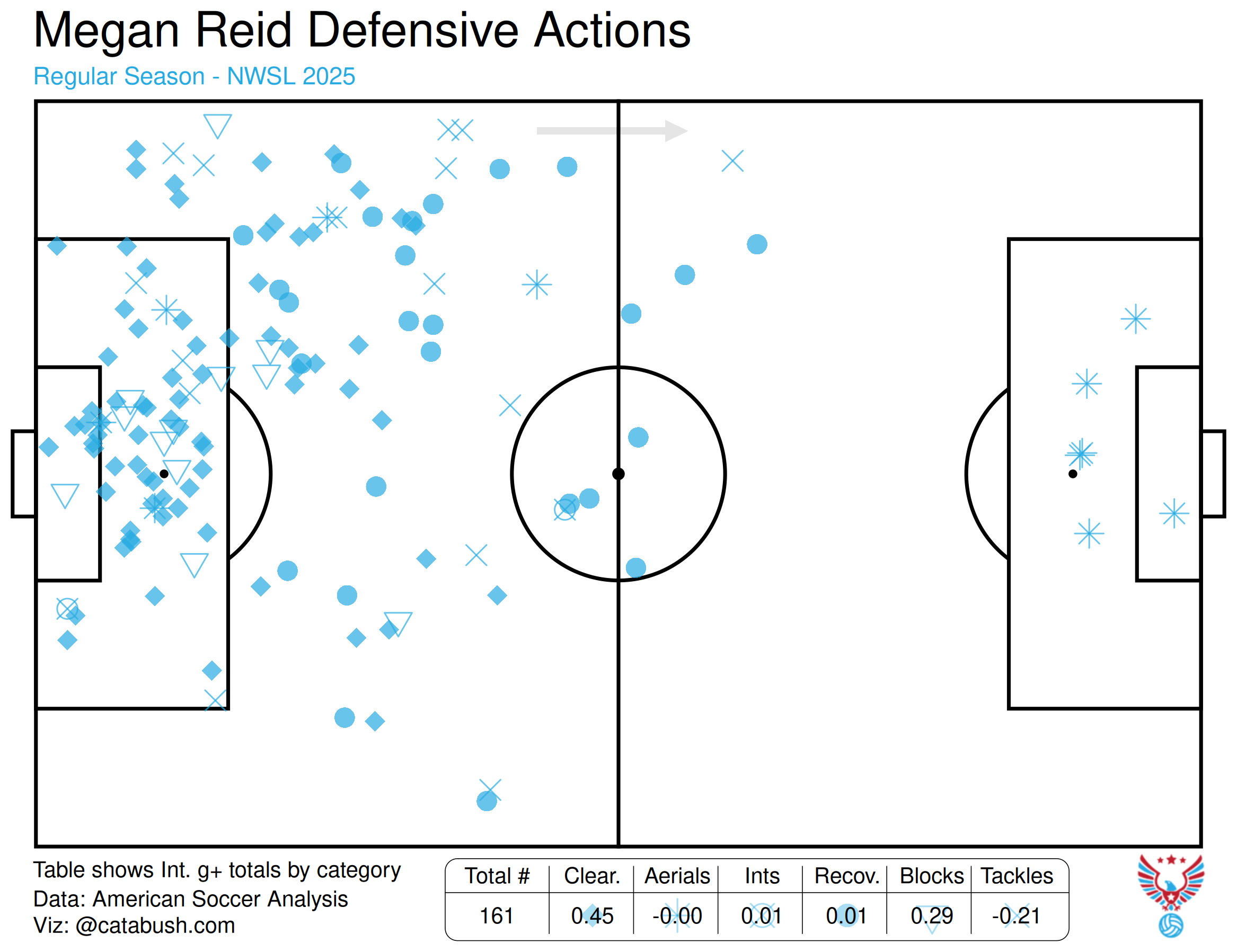
ASA’s chart below shows all Reid’s defensive actions. It’s very clear that she does most of her work inside the Defensive Third. Her g+ score for Interrupting was a -0.12 (37th percentile), but for Fouling it was +0.03 (53rd percentile).
Passing
I never thought that this was Reid’s best skill, but her numbers did surprise my a little. She averaged 56.4 Pass Attempts per 90 (80th percentile), with and 87.1% Completion Rate (77th percentile). Her xPass score was +9.38 (35th percentile). These numbers are not elite, but they are not bad either. Her xPass score is the mark that probably looks the worst, but even so, I actually didn’t expect this number to be positive. Looking at the chart below, though, we see that there is a lot of sideways passing. Reid only averages 6.75 vertical yards per 90 (33rd percentile) and her Progressive Passing ratio was only 32.37% (9th percentile). I think this is also part of Reid’s “Play it safe” mindset. Her g+ score for Passing is -0.15 (31st percentile).
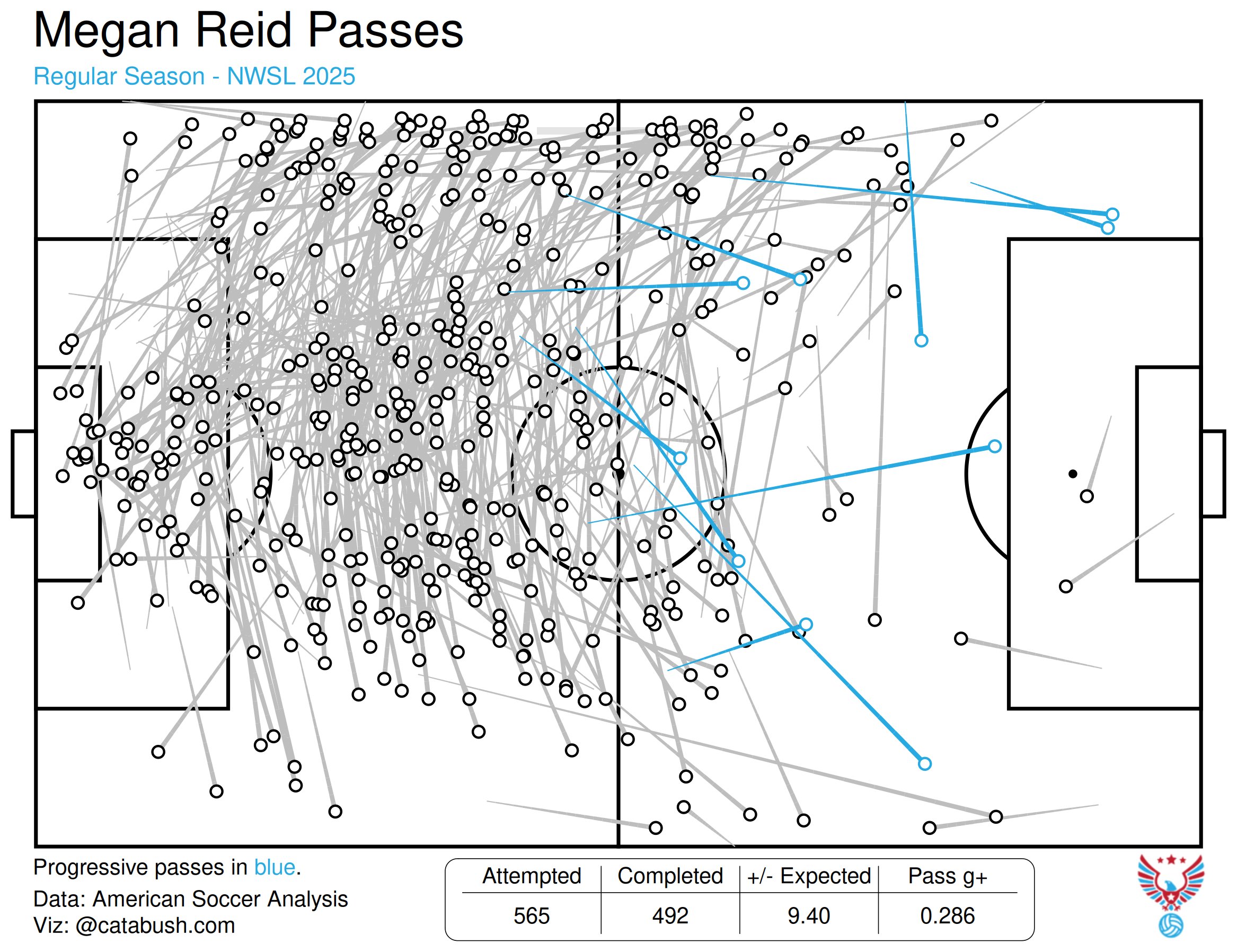
The profile from her passing range also suggests this. Medium Passes were her most common (30.2 per 90), followed by Short (16.2) and Long (8.9). This suggests to me, along with her pass chart, that Reid was doing most of her passing when the backline was spread out and not under too much pressure. There was not too much quick interplay to break pressure, or incisive passes forward to the midfield, breaking the first line. These passes look almost entirely like they are out wide to her left back, or across to her centerback partner. I wanted to compare Angel City’s defensive group, in this regard, so I created the radar plot below.
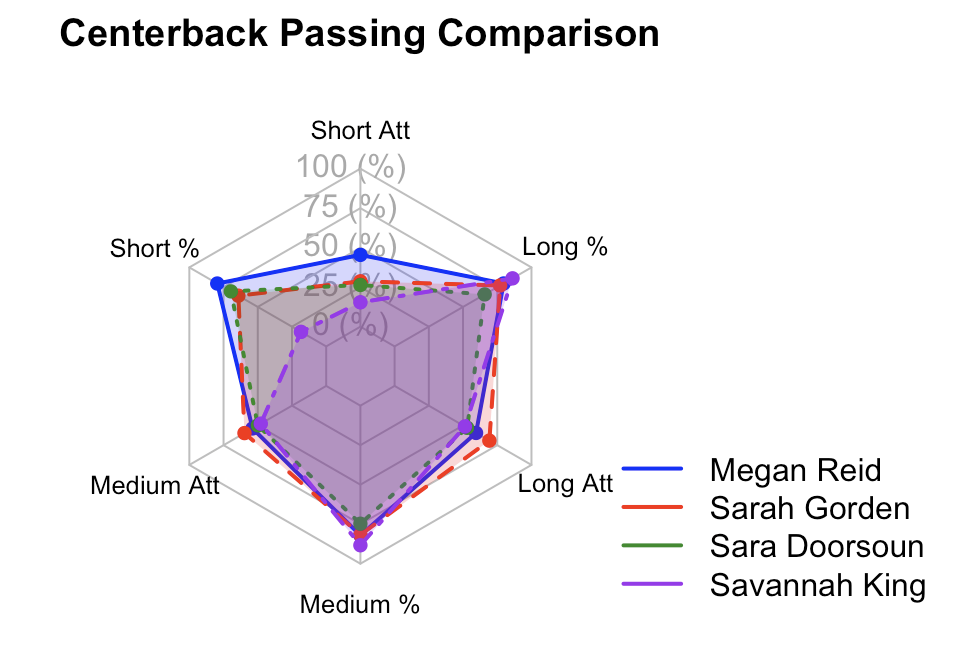
While Doorsoun and Gorden both are pretty similar here, Reid has a significant difference in the number of short passes that she plays. King’s is very different, and I’ll cover that in her section. Reid is pretty comparable to her teammates in Long Pass Attempts, but the number of Short Attempts represents a larger portion of her overall passing volume.
Possession
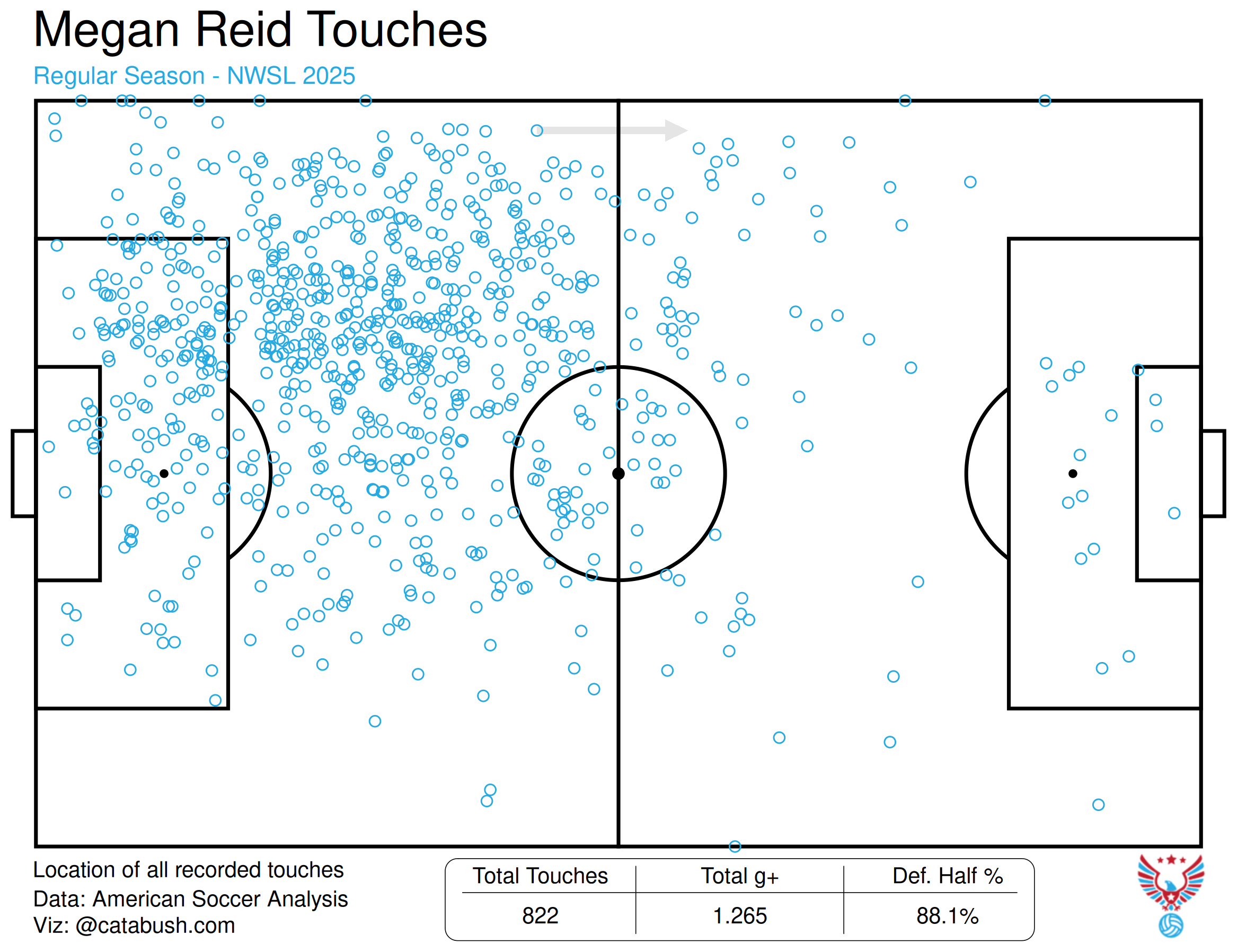
Reid’s possession was all about Defensive Third. 42.3 Touches in the Defensive Third, 24.5 in the Middle Third, and 2.9 in the Attacking Third. Those Attacking Third Touches, while small, do put Reid in the 47th percentile, but I think that this is largely due to her involvement on set pieces. She had 7% of her team’s Touches, much lower than her fellow ACFC centerbacks, but this could be skewed by her high number of substitute appearances, where she sometimes came on as an additional centerback. 88.1% of all her Touches came in the defensive half. Her g+ score for Receiving was +0.1, which is surprisingly high to me. That was in the 70th percentile of centerbacks.
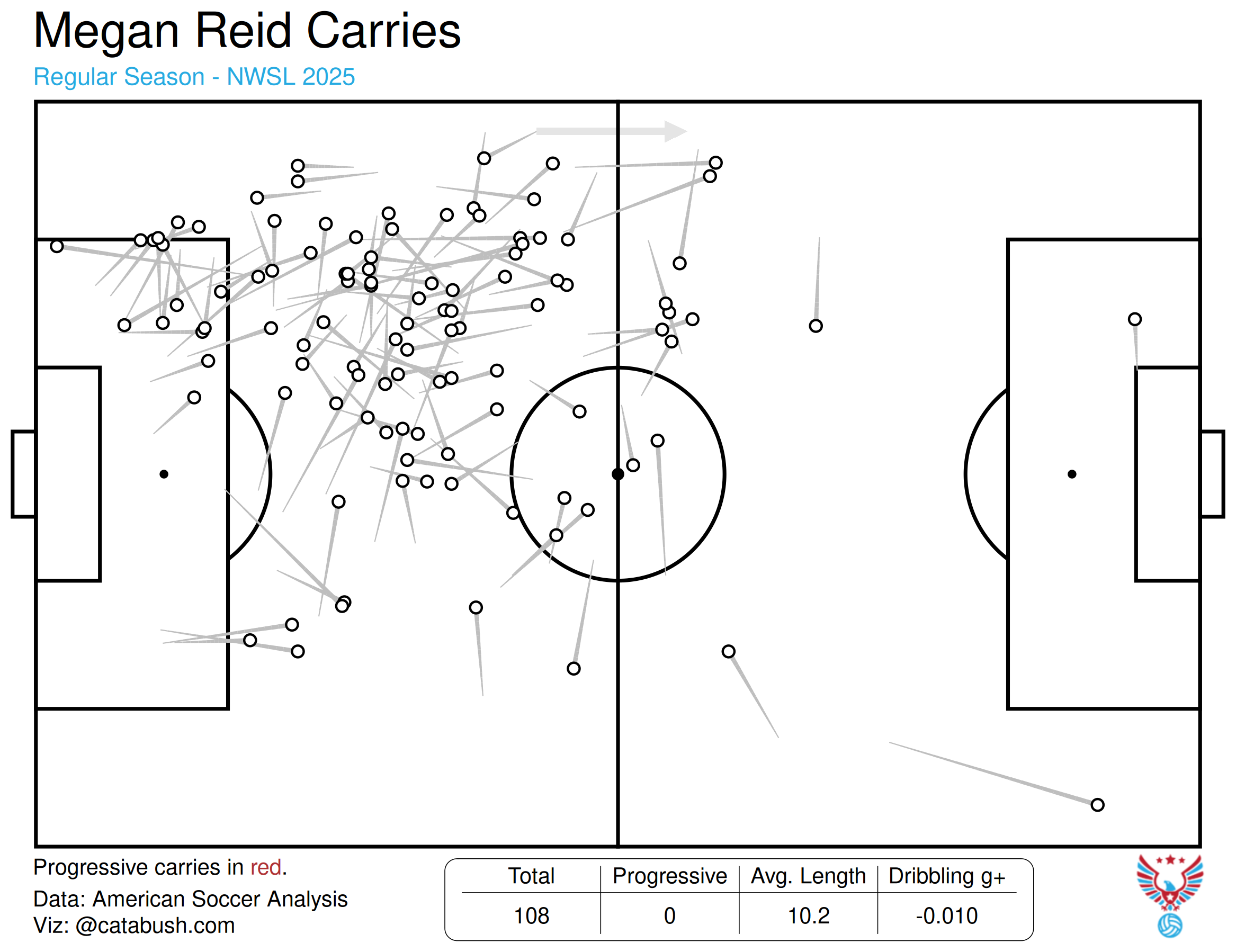
Reid’s number of Carries was also surprisingly high, I thought, as I never viewed as too much of a dribbler. She averaged 35.4 Carries per 90 (65th percentile). However, as can be seen in the chart below, many of these were actually backward, and few, if any, were progressive. ASA credits her with no Progressive Carries, while FB Ref had her at 0.2 per 90 (18th percentile). Reid was also not one to try to beat opponents on the dribble. She had 0.1 Take Ons per 90 (11th percentile). Her g+ score for dribbling was -0.05 (33rd percentile). I think it would be fair to say that most of these carries were about moving the ball away from pressure and not about advancing it.
Offensive Contributions
Reid has good numbers here, though some of that may be skewed by her limited and substitute minutes. Her 3 Key Passes (0.3 per 90, 55th percentile) led to 0.5 xA and 0.3 xAG, though not to any actual Assists. She also had 8 Shots, with 2 on Target for 0.5 xG. She did not score, and I’m sorry that she ended her time with Angel City without a goal because she was certainly deserving of one. She was 7th among all NWSL centerbacks for Shots per 90, but 23rd for xG. ASA considered 3 of her Shots as average, and 5 of them as poor. Still, this was a higher rate of goal threat than any other Angel City centerback provided.
Conclusions
To me, Reid was never an NWSL starter, but she was valuable as a depth player. Writing this, I feel like it may come off as harsh that I keep reiterating that she plays it safe. It is good to be safe, but to excel in this league, I think that a centerback has to offer something more. Her overall g+ score was -0.21 Goals Added, which was right at the 50th percentile. She’s very good at 1v1 battles, I think, but doesn’t have the vision or reads the game well enough to control her whole area of the pitch. She doesn’t make rash passes and give the ball away, but consequently doesn’t create too much either. Or possibly, this is just what coaches have asked of her. If you don’t know her story, Reid initially worked as an EMT after college, and didn’t seem to be on the path for a professional career. When she got her chance, I think that it was probably a good thing to be known as a safe, reliable player. That is probably what gave her a professional career. And I do think that she grew over her 72 games for Angel City, which I think might be tied for most ACFC appearances with Gorden, and should be celebrated.
Reid’s contract expired at the end of the season and she has gone on to sign with Denver Summit. By all accounts, she is a great teammate, and I think that she was a good option as a #3 centerback. I think that Denver will be happy to have her, and I certainly wish her the best. However, I would have really liked to see a European team go for her, where teams are fighting not to be relegated. Someone like Leicester, that play in a low block, don’t have much possession, and are facing wave after wave of attacks. I think that Reid could be a superstar on a team like that, getting in massive numbers of blocks and tackles.
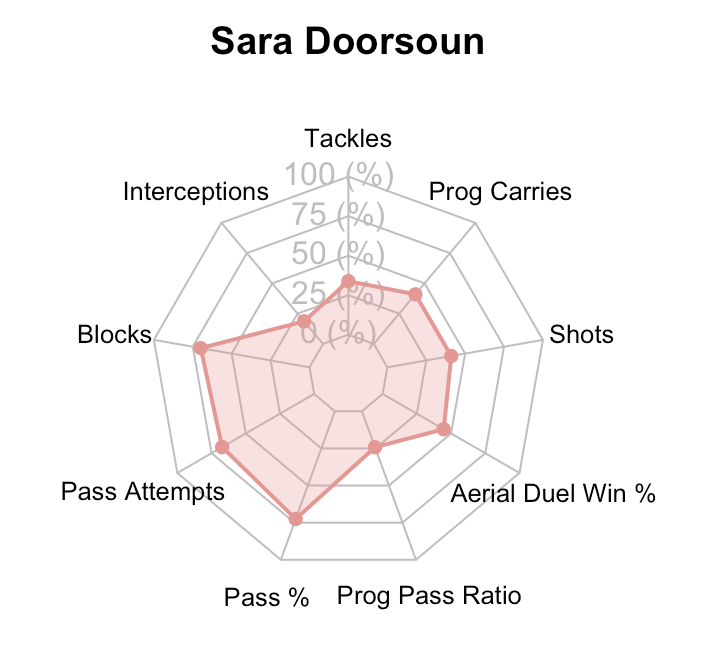
Doorsoun came in midseason and had only a brief time with Angel City. She played in 8 matches, with 7 starts, for 632 minutes. She also had 2 matches as an unused substitute, but these were both right at the beginning, when I think she was still acclimating to the team. I had high hopes for Doorsoun. She has 44 caps for Germany that span almost a decade of service, and also seemed like we might finally have a goal threat from centerback. She had 4 Goals last year for Frankfurt, and 3 Goals the year before that. In the end, however, Doorsoun didn’t take the league by storm.
Defense
Doorsoun’s defensive statistics are largely in line with what we saw with Gorden and Reid, although I think that Doorsoun is slightly more aggressive. She averaged 2.0 Tackles per 90 (78th percentile), which is the highest rate of ACFC centerbacks, though just slightly ahead of Reid’s 1.9. Doorsoun’s 1.57 Blocks per 90 is in the 90th percentile, but as we see with the others, her interception rate is very low (0.57 per 90, 16th percentile). Her overall Tackle + Interception rate (2.57) puts her in the 53rd percentile. This, I feel, is most reflective of my own observations. She didn’t look bad defensively, but league average seems about right (acknowledging, of course, that the NWSL is one of the best leagues in the world).
Doorsoun won exactly 50% of her Aerial Duels (44th percentile), but only actually won 0.43 Aerial Duels per 90 which is only in the 8th percentile, and actually one spot below Gorden. As I mentioned, at least one of a centerback partnership really needs to be dominant in the air, and of Angel City’s most common backline and goalkeepers, only Shores really stood out as able to win the ball in the air.
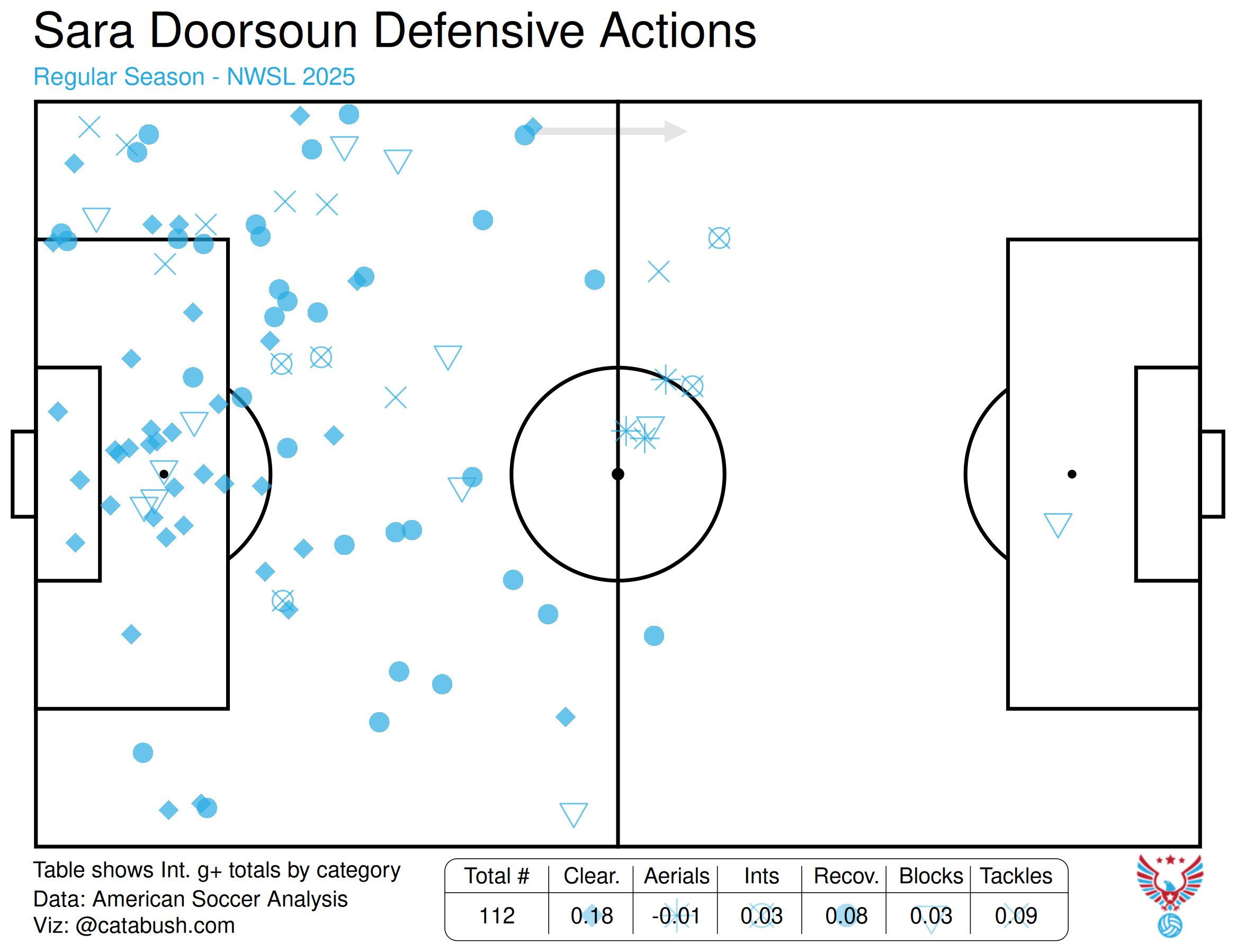
Similar to Reid, we see almost all of Doorsoun’s defensive actions happening inside her own half, and generally, inside the Defensive Third. Doorsoun was actually 10th in the entire league in Tackles in the Defensive Third. This is also, possibly, just representative of the changing tactics over the course of the season. But for comparison, we can look at Gorden’s Defensive Actions from the same time frame as Doorsoun’s, and Gorden was getting more involved higher up the field.
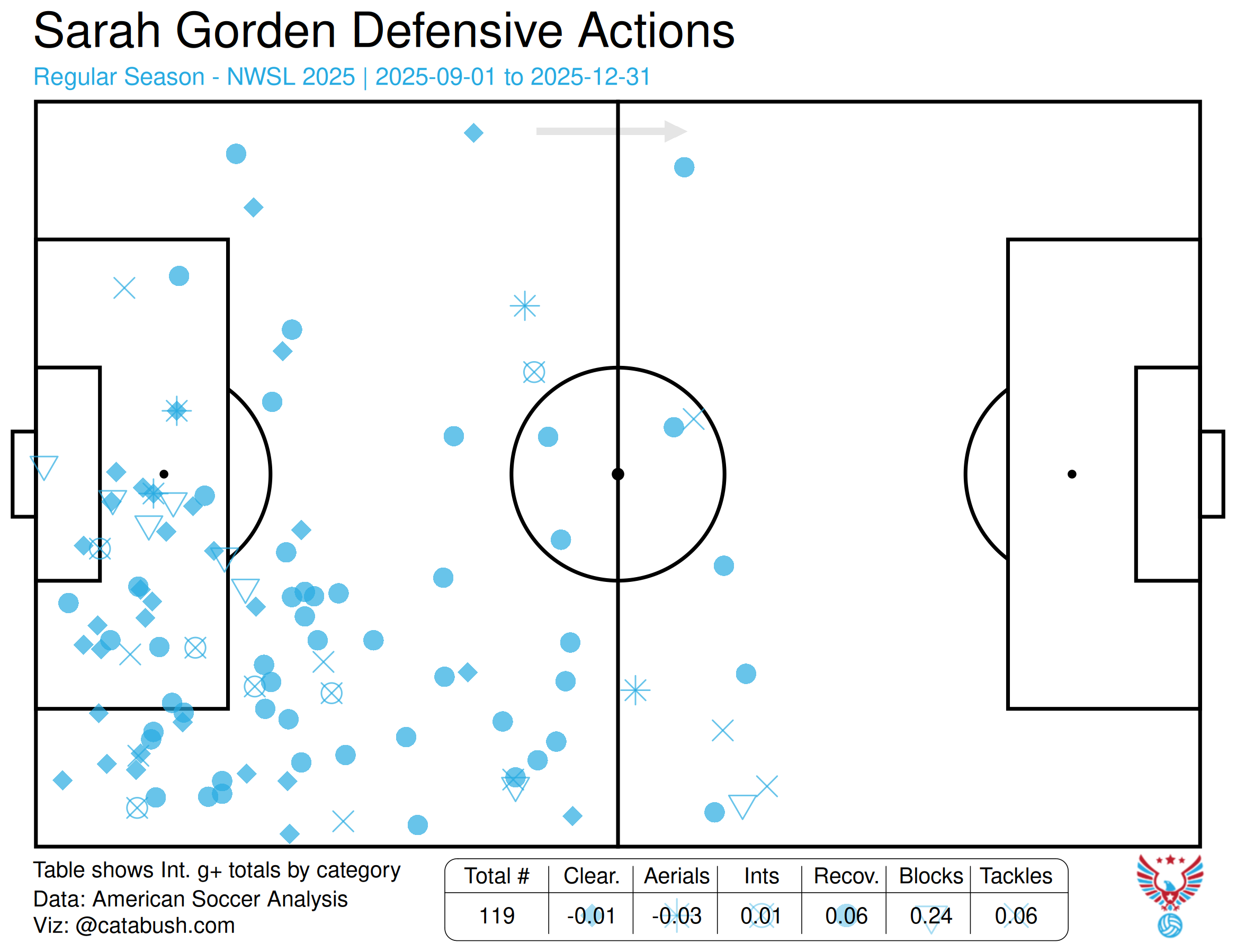
This is a little surprising, as Doorsoun’s previous team, Eintracht Frankfurt, is not one to sit back and absorb pressure. Last year they had 61.8% Possession and scored the most Goals in the Frauen-Bundesliga. Of course, it’s possible that she was asked to stay back, but my point is that this is not the style that she was used to playing. My impression is that Doorsoun was worried about the more transitional nature of the NWSL, and drops deeper to avoid getting beat. Gorden can rely on her speed to get back if necessary, so she is willing to venture further forward. Of course, when Angel City went to a 3 back, that also gave Gorden more license to go forward. Except that as we saw in Gorden’s Possession section, she wasn’t generally playing further forward. It seems that it is just when the team is out of possession that Gorden is more willing to engage further up the field. So while Doorsoun has good Tackling numbers, it does appear to me that she is doing so by dropping deeper to wait until space is more congested. From my observations, I think that she was good about stepping up into a tackle, but I think that part of her was worried about getting beaten in the open field. It’s not a bad thing to try to turn situations to your advantage, but in this case, that means conceding a lot of the pitch to the opposition.
One other area of note in Doorsoun’s defending is her fouling. She committed 10 fouls, with one yellow card, and drew 2 fouls. Her g+ score was -0.24 (3rd percentile). My impression is that Doorsoun sometimes had trouble adapting to the NWSL, and especially when she was faced with a high press. I think this fouling is representative of that. It is a slightly positive that she was almost never carded, and never sent off, but this high rate of fouling does show that Doorsoun struggled with defending at times.
Passing
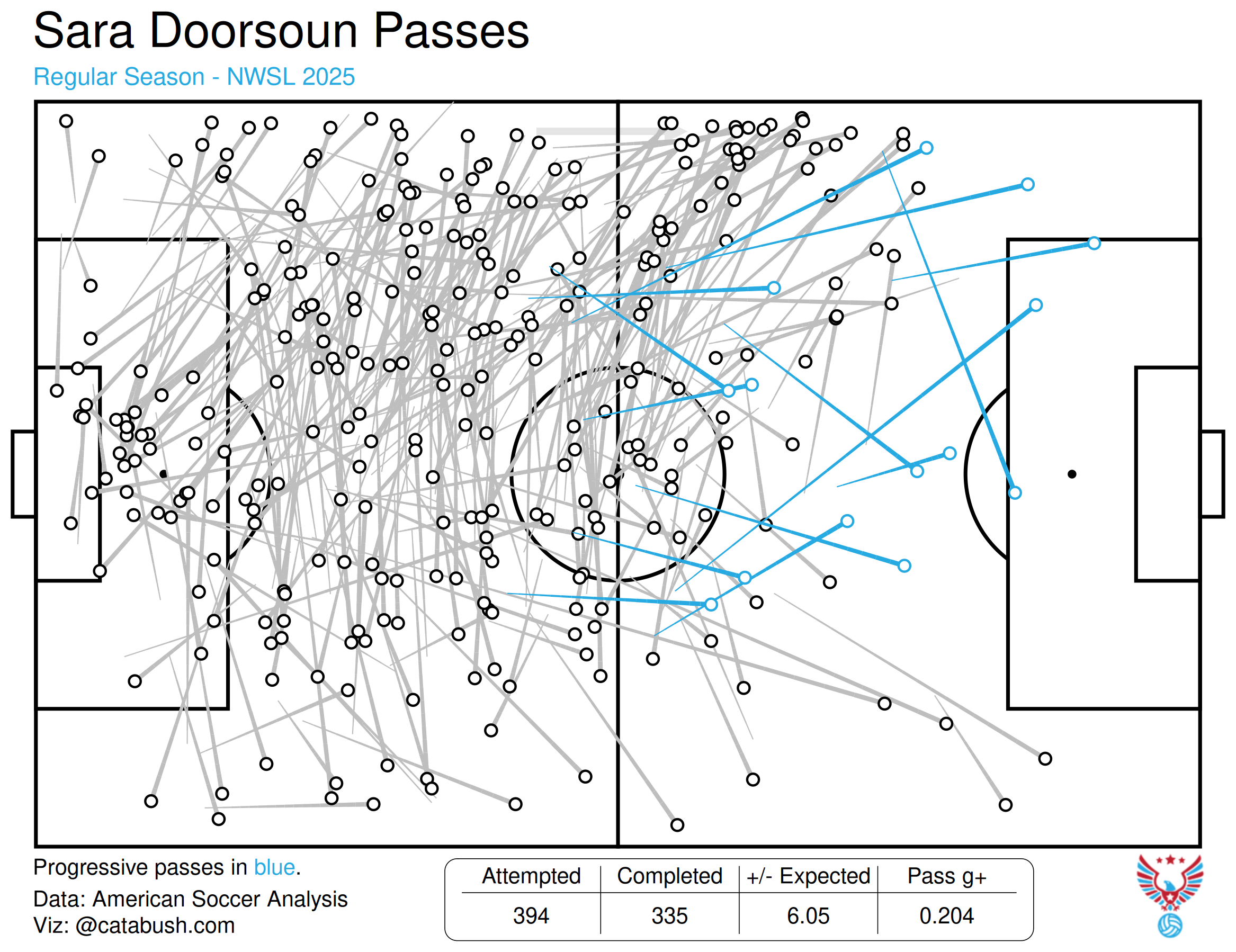
This was the area in which I was hoping Doorsoun would contribute the most, as she was averaging twice as many Progressive Passes at Frankfurt in her final season as Sarah Gorden had in 2024. Doorsoun was heavily involved in the build-up play, averaging 56.57 Pass Attempts per game (81st percentile). Her Total Completion Percentage was lower, but still good (84.6%, 65th percentile). However, she was not able to progress the ball the way that I had hoped. Her Progressive Passing Ratio was only 32.77% (9th percentile) and her average Vertical was 6.75 yard (33.3 percentile). Her xPass score was 5.98, which isn’t weighted for minutes, so it is understandably lower than Reid’s or Gorden’s. But it is not a high enough score to stand out either. Her Passing portion of her g+ score is -0.12 (33rd percentile). So unfortunately her passing stats didn’t translate from Germany. Part of this may have been that Frankfurt finished 3rd in the Frauen-Bundesliga in Doorsoun’s last season there. If teams were sitting back against them, she would have the time and ability to play more forward passes. I think that the higher pressing found in the NWSL was a challenge for her. Her season Passing Chart is below, and while I think that it looks better than Reid’s, it is still mostly lateral passing.
Possession
Doorsoun had 10.6% of her team’s Touches (83rd percentile), and that broke down as an average of 37.0 Defensive Third, 28.43 Middle Third, and 2.29 Attacking Third Touches. 79.9% of her Touches were in the Defensive Third. Her g+ score for Receiving was -0.01 (46th percentile), so not really adding or subtracting value. In terms of Carries, her g+ score for Dribbling was +0.07 (74th percentile). Doorsoun had 36.43 Carries per 90 (73rd percentile) and 1.00 Progressive Carries per 90 (76th percentile). The full chart from ASA is below. Doorsoun would attempt 0.43 Take On Attempts per 90 (55th percentile).
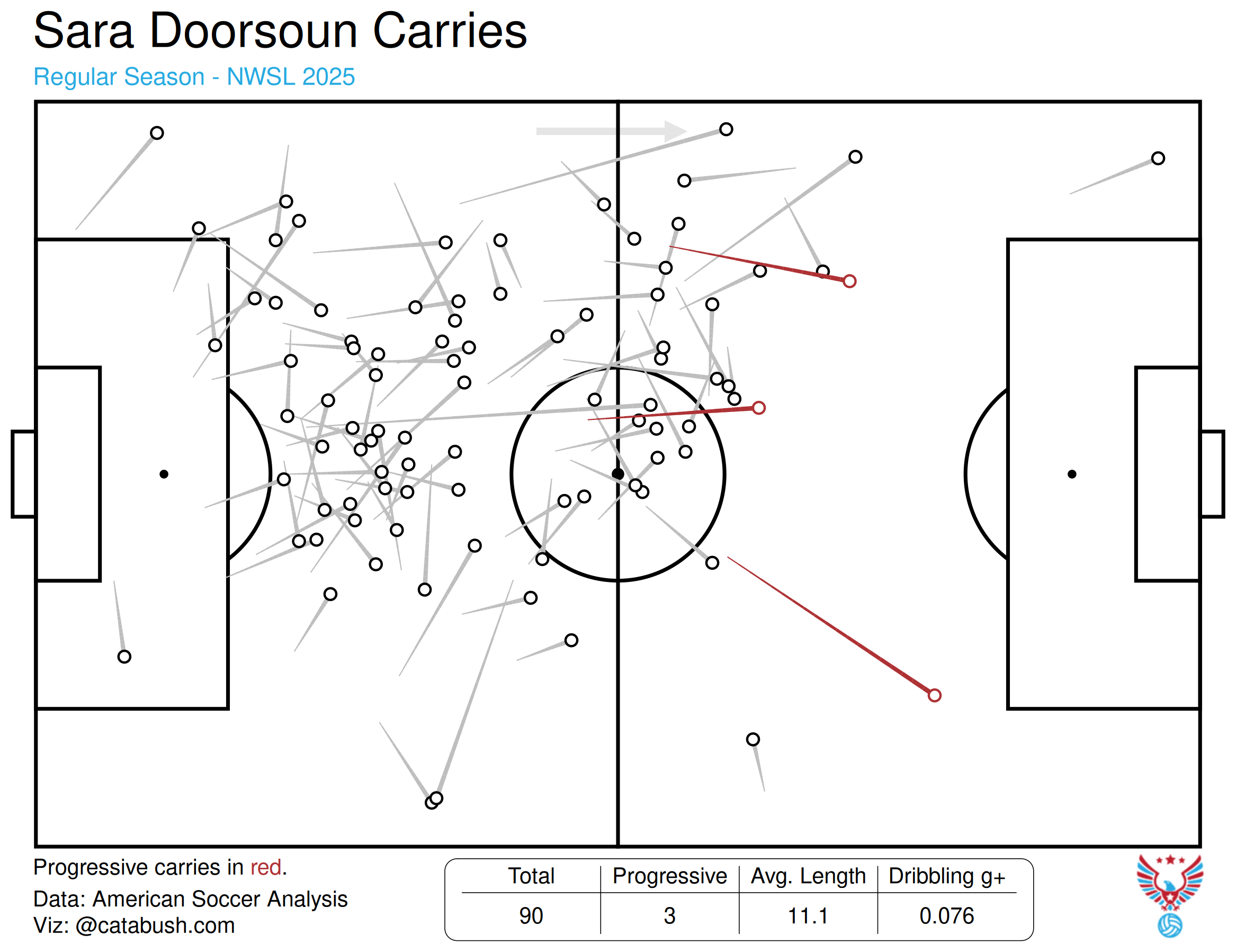
FB Ref and ASA disagree on classifying some of these carries as progressive, but I think that we clearly see Doorsoun doing a better job of moving the ball up the field than Reid. I’m most impressed by the number of Carries she has through the middle of the field. Her Take-On numbers show that she was sometimes challenging opponents directly, not at a high rate, but she was also not shying away from it. I think that Gorden is still the best at bringing the ball up field, but having this ability from both centerbacks can go a long way to breaking an opposing press.
Offensive Contributions
As I mentioned at the start of her section, I had hopes that Doorsoun would be able to bring some goal threat. Angel City really hasn’t had a centerback score since Paige Nielsen in 2023. That did not happen, however. Doorsoun did take 4 Shots, with 2 On Target, for 0.2 xG, or 0.28 xG per 90, which was good for the 41st percentile. Two of the shots were from well outside the box, and ASA only ranked 1 as Average, with the other 3 being Poor. Her shooting did add +0.04 for her g+ score.
In terms of playmaking, Doorsoun only had 1 Key Pass, worth on 0.1 xA. She had 0.43 Shot Creating Actions per 90 (11th percentile). So Doorsoun did not have any great contribution to actual goal threats or to playmaking.
Conclusion
Angel City and Doorsoun agreed to mutually terminate her contract, and Doorsoun has since returned to Frankfurt. I would always like to see some transfer fee made in a situation like this, but that’s not always possible. My impression of Doorsoun’s time at Angel City is that she was fine, but she was also not spectacular, and I consider this to be true for just about every facet of her game. Her total g+ score was -0.11 Goals Added, which was in the 53rd percentile. I don’t think she showed too many weaknesses, but also just didn’t excel in any way to build around either. She would have been a solid depth player had she stayed, but it’s entirely possible that that’s just not the role that she wanted to have at this point in her career. Moving on was probably the right decision for everyone.
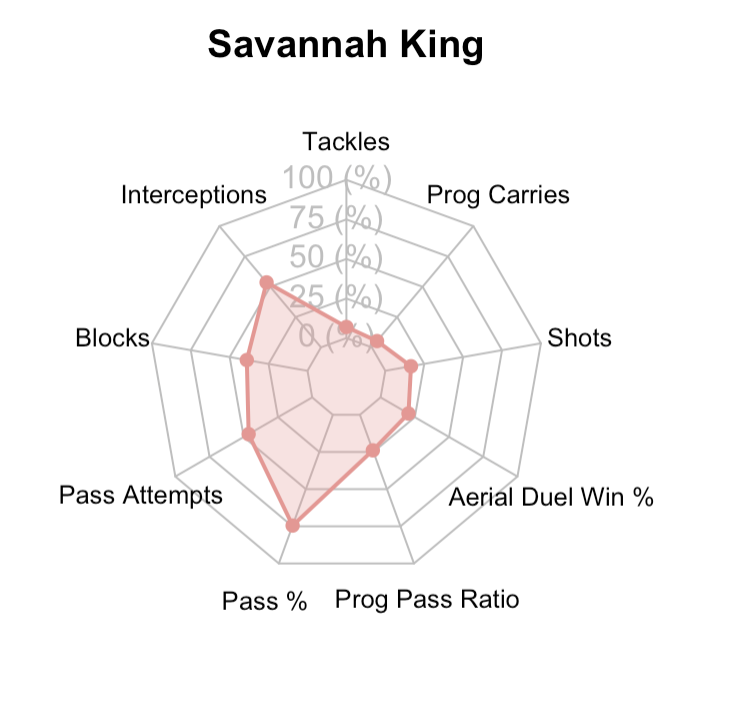
King’s on-field collapse was an incredibly scary moment, even just to witness. It should go without saying, but I do want to reiterate that above all else, we’re just happy to see her recovery, and that she’s back in training. Performance-wise, this was one of the most interesting evaluations for me. King was drafted 2nd overall in the final NWSL draft by Bay FC after one season at the University of North Carolina. She played as a centerback there, and started every match for the Tar Heels, which I think is remarkable for any freshman, and especially at a program like North Carolina. Bay opted to play her as a fullback instead, where she played 1,106 minutes, but I don’t think entirely impressed. Especially as so many others at the top of that draft excelled, like Sentnor, Bethune, and Hershfelt.
I want to emphasize that background, because I think it’s important for the context of her joining Angel City. She wasn’t a rookie, but she only had one year of college and one pro year. She also hadn’t really played centerback in the NWSL. She is just about to turn 21 years old, while Hershfelt (as an example) is 23, so we can’t even compare members from the same draft class on an even basis (and luckily, the draft is a thing of the past now). So while King hasn’t gotten the USWNT call-ups that others from the draft class have, it doesn’t mean that she’s not still on course to get there.
For Angel City in 2025, King had 8 matches, 8 starts, and 708 minutes played. Watching those 8 matches, I fully expected King to be the top centerback by the end of the season. I thought that she looked far more comfortable in that position than at fullback. I thought that she showed good mobility, and that she read the game well. I thought that her passing was also improving as she gained chemistry with her new teammates. I don’t think that the stats fully demonstrate that, as we’ll see as we get into it, but I am still very optimistic about her potential.
Defense
King is an anomaly among Angel City centerbacks in that her numbers are much better for Interceptions than for Tackles. King averaged 0.76 Tackles per 90 (6th percentile), but 1.27 Interceptions per 90 (75th percentile). Put together, that gave her 2.03 Tackles + Interceptions, which was in the 31st percentile. Part of this may be that King had Vignola on her left for all 8 matches, and she was a Tackling machine. During that time, King was credited with 5 Tackles Won, while Vignola had 17. I wrote in her section that Vignola was actually not categorized as an attacking fullback in my unsupervised clustering. I think it is entirely possible that since she was not pushing forward as often, Vignola was usually the one to step forward and engage the opposing ball carrier, and we have established that at Angel City, it is more common for fullbacks to take on this responsibility. There is more to explore here, but I think that there is a chance that King just saw more passes coming her way than dribblers. Her smaller sample size makes that more ambiguous.
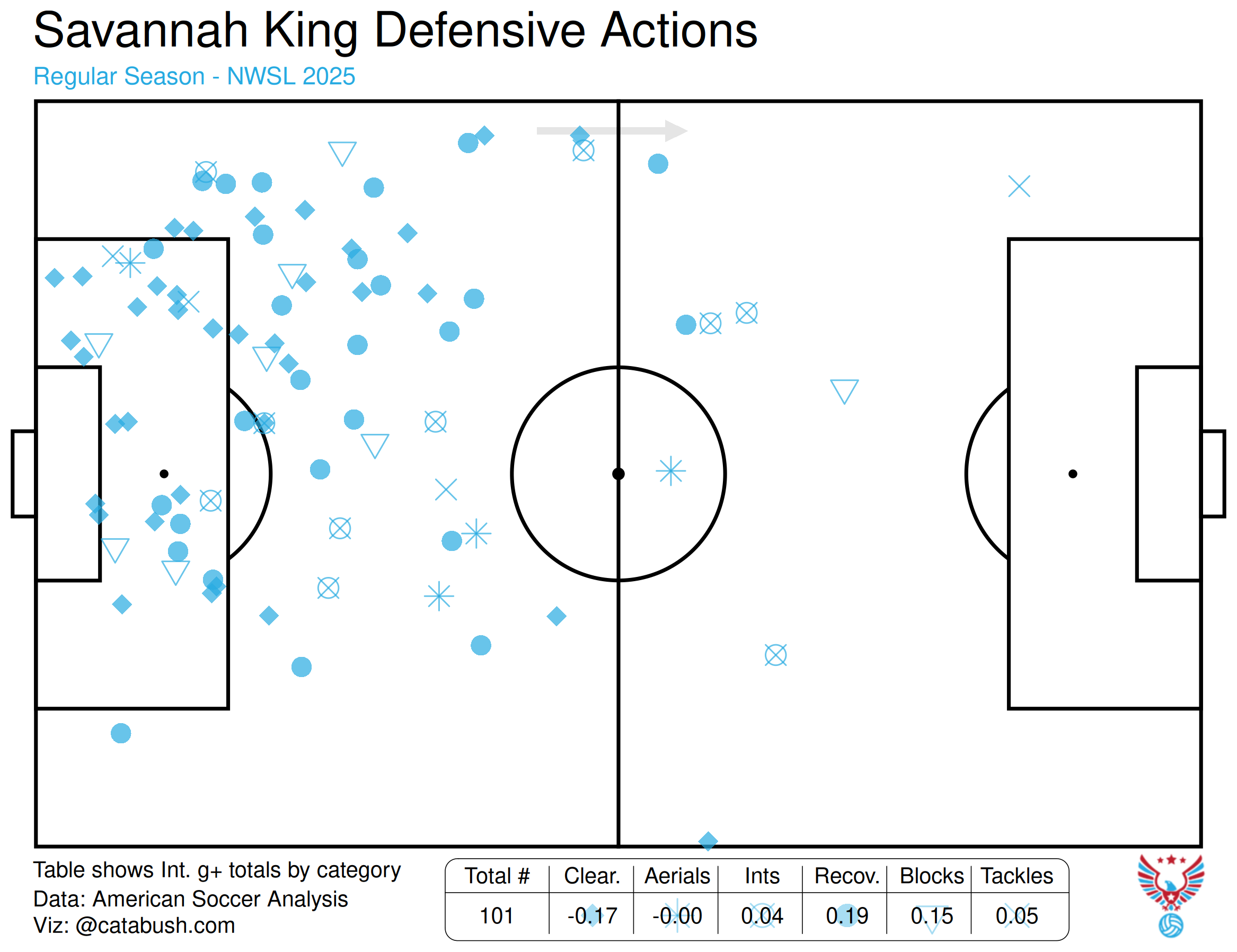
King also had 1.01 Blocks per 90 (40th percentile). She won 0.51 Aerial Duels per 90 (20th percentile) and had a 36.4% Aerial Win Rate. Her g+ score for Interrupting was -0.20 (29th percentile), while her Fouling score was +0.04 (59th percentile). In total, it was 7 Fouls Against, with 2 Yellows, and 2 Fouls Drawn. This isn’t as bad as Doorsoun had, and I don’t think that they were as much panic fouls either. This is an area for improvement, but again, she’s only 20 and playing centerback professionally for the first time. Looking at the chart below, I also see King making more defensive stops outside of the 18 yard box than her teammates are doing.
Passing
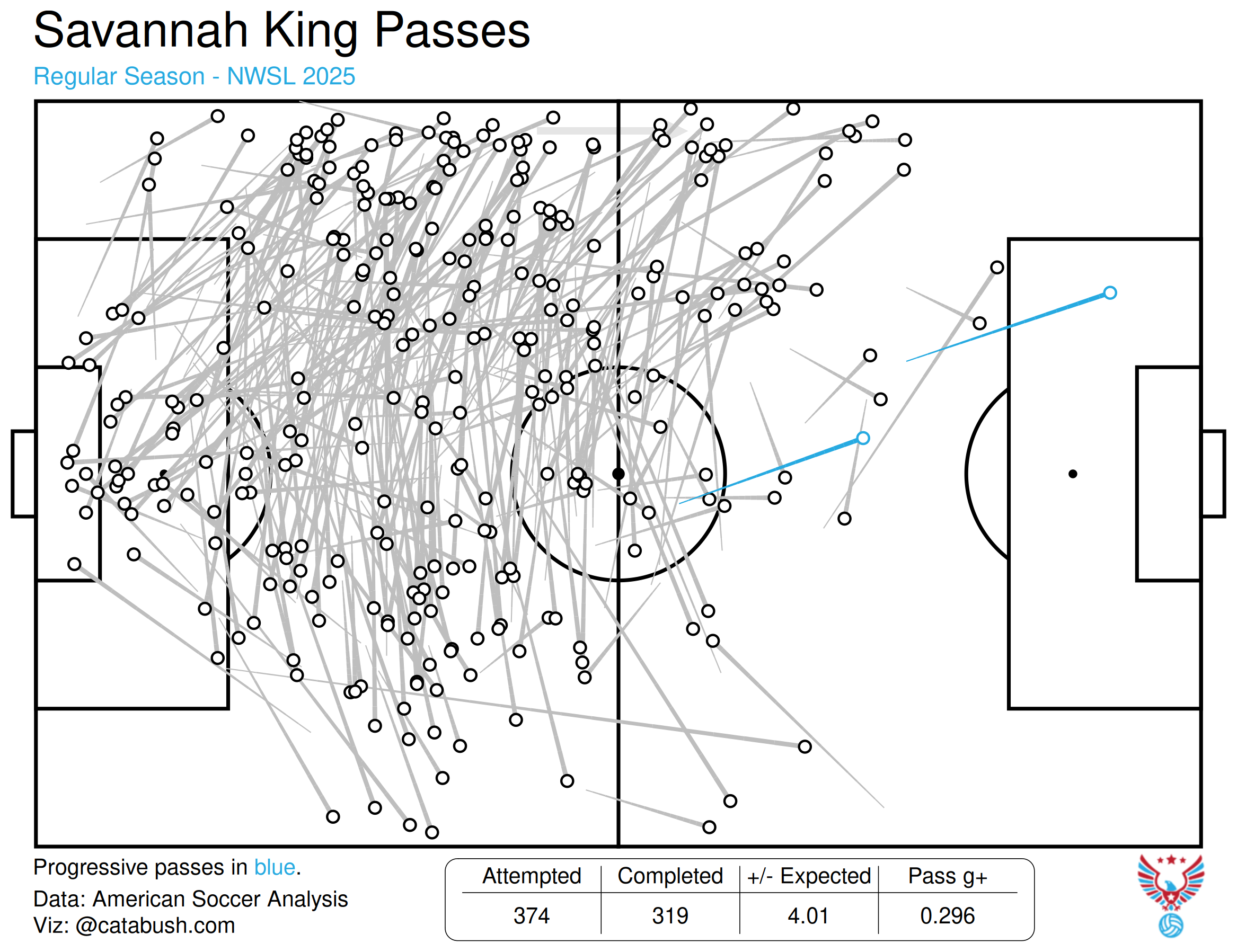
King’s Passing also presents a bit of a conundrum. Her Pass Attempts are lower (47.47 per 90, 33rd percentile), while her Total Pass Completion Percentage is higher (85.1%, 66.67 percentile). The thing that really stands out is her Short Passing. King only averaged 10.76 Short Pass Attempts per game, one of the lowest marks in the league. And her Short Pass Completion Percentage (81.2%) is also one of the lowest marks in the league. It’s incredibly unusual to see a player have a higher overall passing percentage than a short passing percentage. It’s common sense that the longer the pass, the more obstacles you face, and the harder it is to complete. I am going to also chalk this up as an anomaly that would have been sorted out, if not for the low number of minutes that King ended up playing. As King is among the top 10 centerbacks in Passing Completion Percentage for both Medium and Long Passes, I think that it’s clear that she’s not a bad passer, which was also my observation. I fully expect to see some positive regression in her Short Passing in 2026.
The next question, of course, is the value of that passing. King’s xPass score was 4.01, but again, it should be taken into account that she only played 8 games. She averaged 6.86 Vertical yards (37th percentile), and her Progressive Passing Ratio was 32.68% (12th percentile). The Passing section of her g+ score was -0.05 (44th percentile).
All of these range from okay to not very good, but this is why the context is so important. King joined Angel City at the start of February, so had some preseason with the team, but not an entire preseason. They were playing under a new coach, who only held an interim tag. She was playing a different position from what she did the entire previous season. For all of these reasons, I give more grace to King in this regard than I do to Gorden or Reid, who are both very familiar with the team, or even Doorsoun, who is a veteran that has played for multiple teams, and has national team experience that should help her hit the ground running. Passing requires both teammates to be on the same page, and that’s what I think was missing. Her technique always looked good to me, as did her decision making and vision. I think that if she had played the full season, we would see these completion percentages and passing values go up.
Possession
King had 10.2% of the team’s Touches, in line with other ACFC centerbacks. 85.3% of these were in the defensive half, with an average of 32.91in the Defensive Third, 22.78 in the Middle Third and 1.65 in the Attacking Third. She never received a Progressive Pass, and her g+ score for Receiving was -0.09 (33rd percentile). This is an area of improvement, I think, as both Read (0.10) and Doorsoun (-0.01) had higher scores playing in basically the same position.
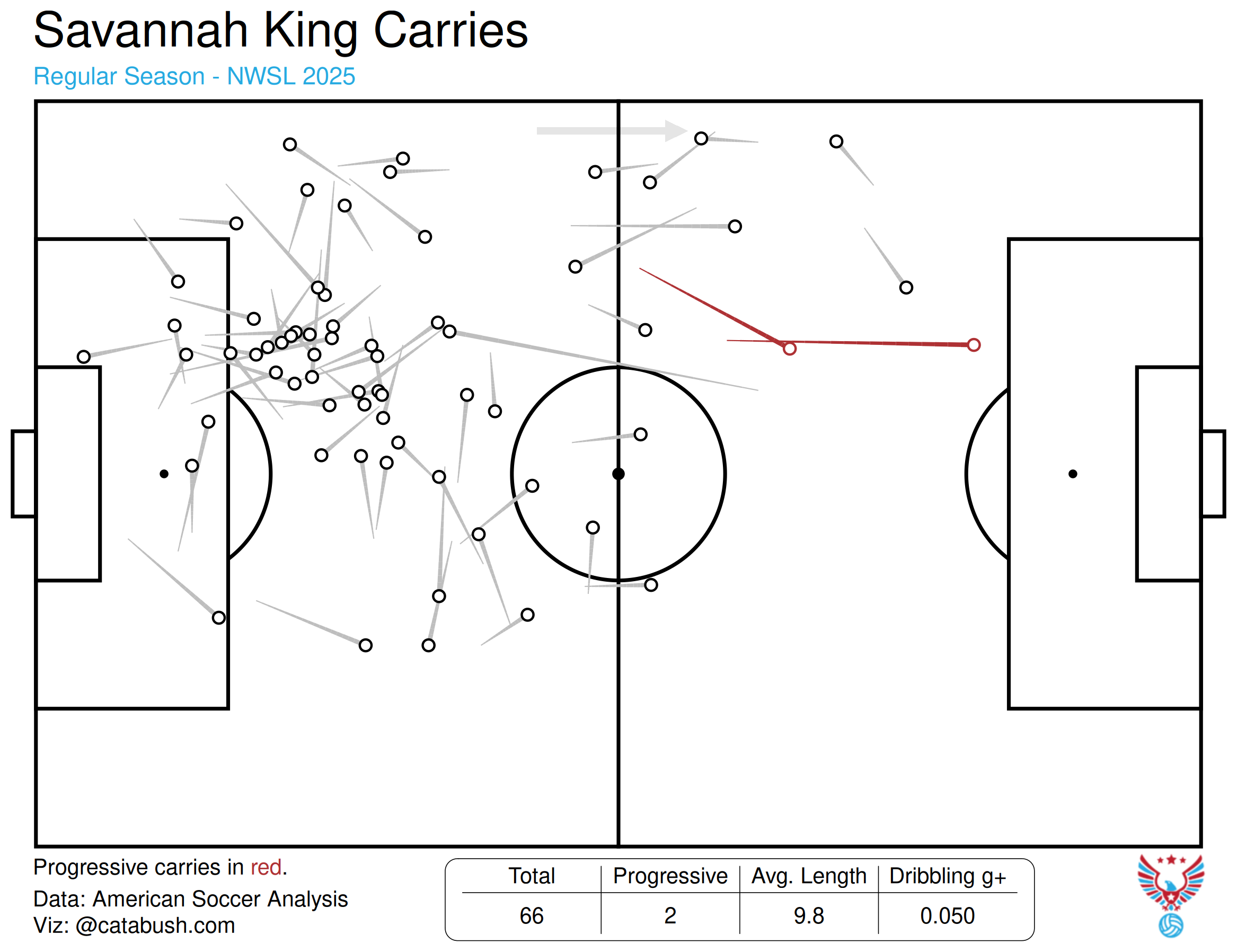
King had 29.2 Carries per 90 (40th percentile), and 0.13 Progressive Carries per 90 (13th percentile). These were generally pretty short in length, with my calculations having only three players with a lower average carry distance. The Dribbling part of her g+ score was 0.05 (68th percentile), so while she wasn’t carrying the ball much, she was finding some small value in the dribbling that she did do. I’m also less worried about her dribbling, as the traditional thinking is that it’s best to have one centerback that ventures forward, and one centerback that stays home. For 2026, both Sams and Gorden are known for carrying the ball, so I think that King is always likely to be the stay-at-home player. If King can improve her receiving position to occupy more important areas on the field, which I think that she can, I think that the Possession aspect of King’s game will be just fine.
Offensive Contributions
There is little to discuss here. King had 1 Key Pass for .1 xA (18th percentile and 23rd percentile respectively, per 90). She had 0.38 Shot Creating Actions per 90 (8th percentile). King also took 2 Shots, neither of which was On Target, for 0.013 xG per 90. At 5’6”, King doesn’t ever project to be a real set piece target, but I would expect that given time, her SCA’s will improve. This is because she already has a good Long Passing Completion Percentage, and as I stated in that section, I think that her passing will continue to improve with playing time.
Conclusions
I see a lot of potential in King. I think that she very much fits into the mold of a modern ball-playing centerback (which is where my clustering model placed her). She has good mobility and I think does a good job of snuffing out danger before it’s trouble. We’ll have to see how her health is, but I know she’s back in training and everything I’ve heard has been good. I sincerely hope that her heart isn’t a concern moving forward.
King’s Total g+ score was -0.29 (35th percentile). She’s not at the elite level yet, but I think that she can reach that level. I think that what she needs is stability, and if she plays the full season at centerback, I expect to see great progress from her. There are lots of markers that are incredibly encouraging, like her Long Passing and her Interceptions. King is signed through 2028, and I think that we’ll look back on the $300,000 that Angel City paid as an absolute bargain.
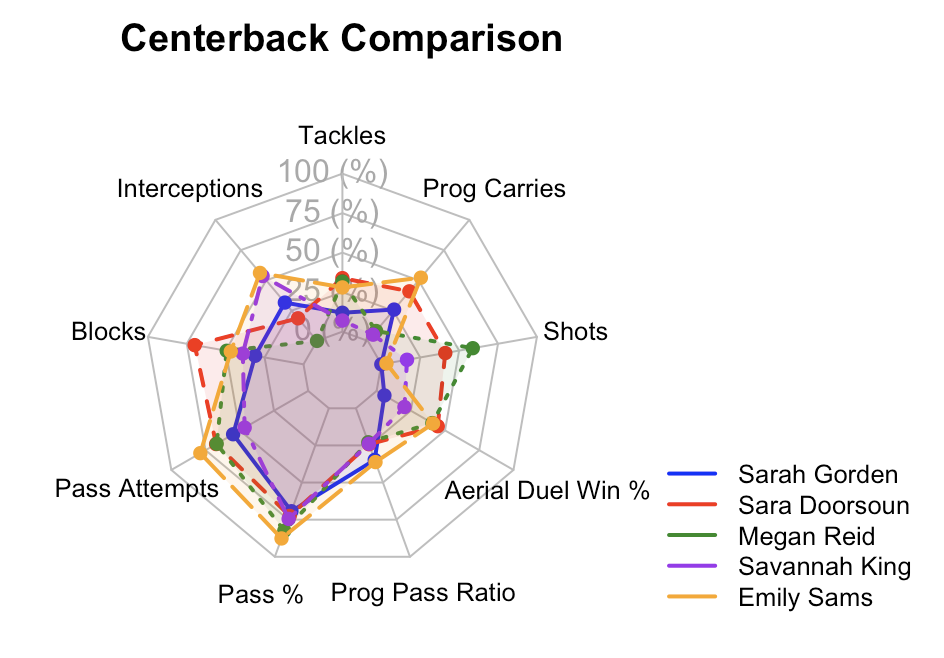
I put the radar plots together for all four ACFC centerbacks, and added Emily Sams in as well, as something of a preview for next season. I won’t do a full report on her, but we can see from the chart that she is clearly better than any current centerback. Last season, only two teams allowed more goals than Angel City. That was not entirely on the centerbacks, by any means. But an improvement here can make a big difference. Sams definitely represents an improvement, but at the same time, we also lost Reid and Doorsoun. Even so, I think that this might be the strongest Angel City centerbacks have ever looked. If it’s a back four, any combination of Sams, Gorden, and King is going to be strong. If it’s a back three, we may see all three of them. Karsyn Cherry was also signed from the University of Louisville, so there is depth beyond these three. My hope is that having stronger centerbacks is going to give more freedom to other positions. I’m looking forward to seeing how Straus plans to implement them.
Note: During the writing of this article, Opta ceased providing advanced statistics to FB Ref. This removed a major source of publicly available information for soccer in general, and while I did save many datasets from the 2025 season, this will impact Goosecat moving forward. Please share any additional sources of public data that you may know of.
All data is from FB Ref and American Soccer Analysis. Some ASA visualizations were used, in addition to ones that I created, and should be marked as such.