ACFC Goalkeepers 2025
Most of these are going to be more player by player, but with the goalkeepers, I found it a little more difficult not to be comparing Anderson and Seabert. So this article will mostly focus on Anderson as she played 84.6% of the available minutes, and most of the discussion of Seabert will be in relation or comparison to Anderson.
With Harčić departing as a free agent, no replacement was brought in, and Anderson was again the #1 choice in goal. She had claimed the spot late in 2023, only to lose it in early in 2024. This year Anderson was also made vice-captain, which did suggest that there was belief she could make the job her own, which was mostly true.
She finished the year with 22 matches played, all starts, and 1,980 minutes. She allowed 37 Goals from 103 Shots Against, for 68 Saves, and a 68% Save Percentage. That puts Anderson in the 25th percentile of NWSL goalkeepers on a per 90 basis for Goals Allowed and Save Percentage. The statistic that I like the most for goalkeepers is PSxG +/-, which compares the sum of the PSxG for all Shots on Target with the sum of the actual Goals Allowed. Anderson finished with -1.4, which puts her in the 19th percentile. She finished with 2 Clean Sheets, and her 9.1% Clean Sheet Percentage was in the 8th percentile.
None of this looks good, but I don’t think that it tells the whole story. I think that the PSxG+/- numbers are tied to the lack of clean sheets. Because any goal will bring this down (e.g. a goal with a PSxG of .7 is practically guaranteed, and yet it brings down a keepers PSxG+/- by .3). This is also partially just my feelings, in that I really couldn’t remember any goals against this year where I thought Anderson was particularly at fault. So I went back through the match reports to look at all the goals that she let in.
To begin with, of the 37 goals that Anderson allowed, 5 were penalties (technically she saved one penalty, but Rodman immediately pounced on the rebound). There were also 3 Own Goals, plus a goal credited to Matsukubo, because it was on target, but Gorden very definitively deflects it away from Anderson’s dive and into the net. Removing those 9 Goals would give Anderson a 1.27 Goals Allowed per 90, which is better than the league average of 1.33, and would actually place her 6th in the league, just ahead of Jane Campbell.
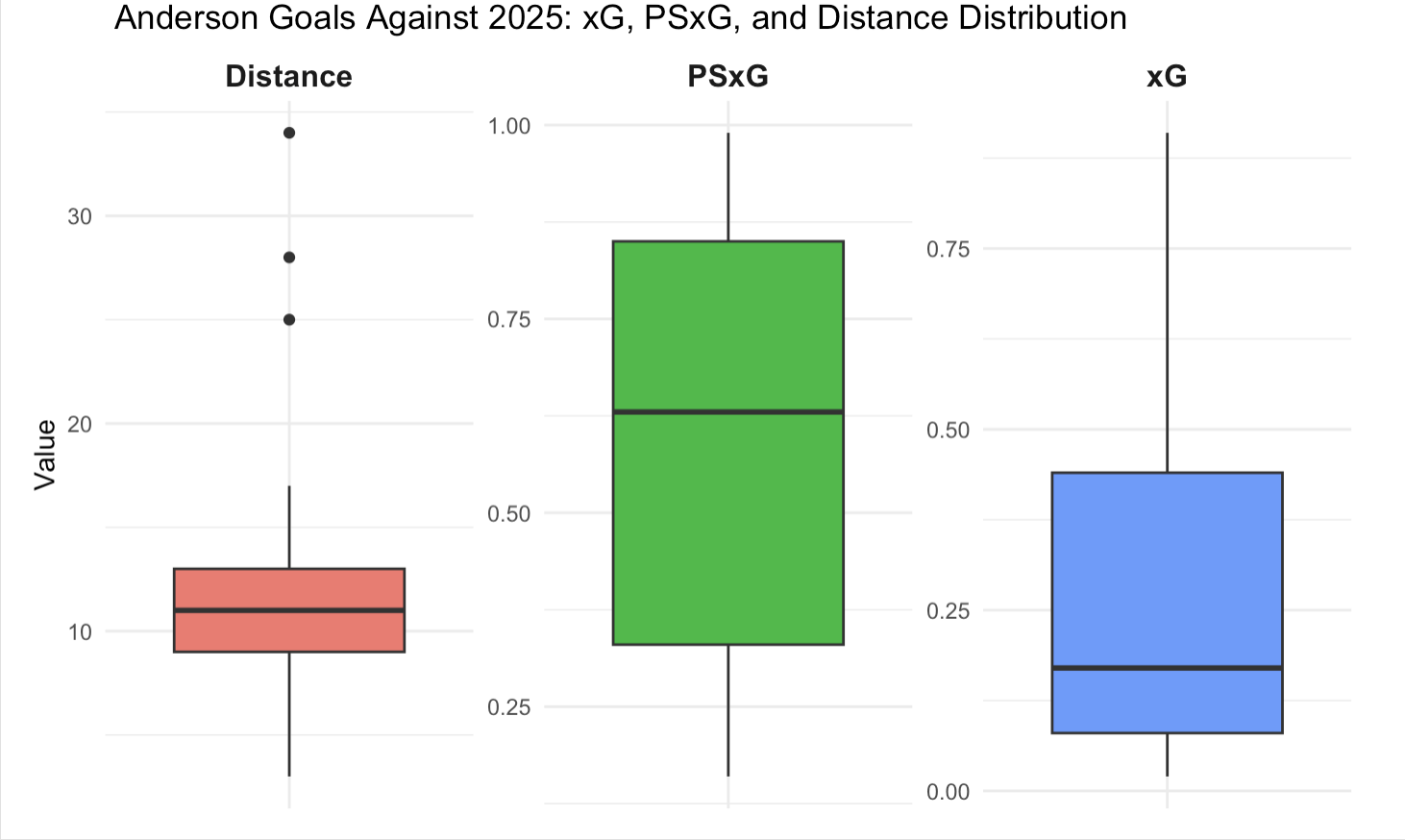
But also, looking at the actual Goals Allowed, I don’t really see any soft goals. In the plots above you can see the distribution of the Goals by Distance, xG and PSxG. The median Distance of 11 yards is closer than the penalty spot. I also noticed that the PSxG was higher than the xG on every goal but one. That one was the goal that Bia scored on the rebound, right after Anderson had made a big stop on Chawinga on a breakaway, and I think the defense really needed to help on that. I’d have to do a league-wide analysis to determine what the usual rate is here, but that does say that every shot was well struck. 20 of the 34 Shots that resulted in Goals Allowed had an xG of at least .15, or what I consider to be a good chance. Of the 14 that didn’t, the lowest PSxG of these was still .16, and that was Schlegel’s rocket for Chicago from 34 yards out that I would consider for Goal of the Year. It was a shot with venom and movement, and while I think that Anderson’s positioning could have been slightly better, this was a true golazo. In fact, of the 8 shots with a PSxG below .3 that Anderson conceded, 2 were deflections, and the other two were the Bia rebound and Schlegel golazo I mentioned above. In fact, the mean xG on Goals Allowed was .28 and the mean PSxG was .59. Basically every goal Anderson allowed was a good chance and a good shot.
On top of this, I also counted 33 Saves that Anderson made on Shots that had a PSxG of .15 or higher. That is 1.5 good shots per game that Anderson keeps out of the net. Also, she had 11 Saves on Shots worth .4 PSxG or higher. I would have to calculate these rates for every keeper in the league to really assign significance, and that is beyond my scope at this moment, but this is at least demonstrating that Anderson has made some big saves over the season. I think that gets overlooked, because Angel City still lost most of these games.
Next we turn to passing, which is slightly harder to judge for keepers because so much of it is about the system. Anderson had Launched 26.1% of her passes, which is in the 69th percentile, and she completed 30.7% of these, which is in the 25th percentile. Neither of these stand out, but comparing across all keepers means that these are not like-for-like comparisons. The best comparison is to Seabert, and Anderson averaged 7.6 more Launched Passes per game than Seabert did. That corresponds with Angel City’s shift toward a more direct style, in the 3-4-2-1 formation, towards the end of the season.
The largest difference between the Angel City keepers that we see is in the Percentage of Crosses Stopped (Anderson is 3.8%, while Seabert is 1.9%). This is not reflective, in any way, of a lower volume of crosses for Seabert, as she actually faced 2.5 more Crosses per 90 than Anderson. Even so, Anderson’s 3.8% is only in the 14th percentile. This is also a factor of systems, however, as the keeper with the lowest qualifying percentage (Sheridan, 3.0%) and the highest (Berger, 14.8%) are both among the best in the world.
At the surface level, Seabert’s stats are all better than Anderson’s. Her Save Percentage is almost 10% higher (77.8% to 68%), and her Goals Against per 90 is .68 lower (1.68 to 1.0). The big caveat in all of this is sample size. Seabert only played 4 matches for 360 minutes. This is too small, even, to be included in FB Ref’s percentile rankings, but from my own scraping, I can provide radar plots for both Angel City goalkeepers.
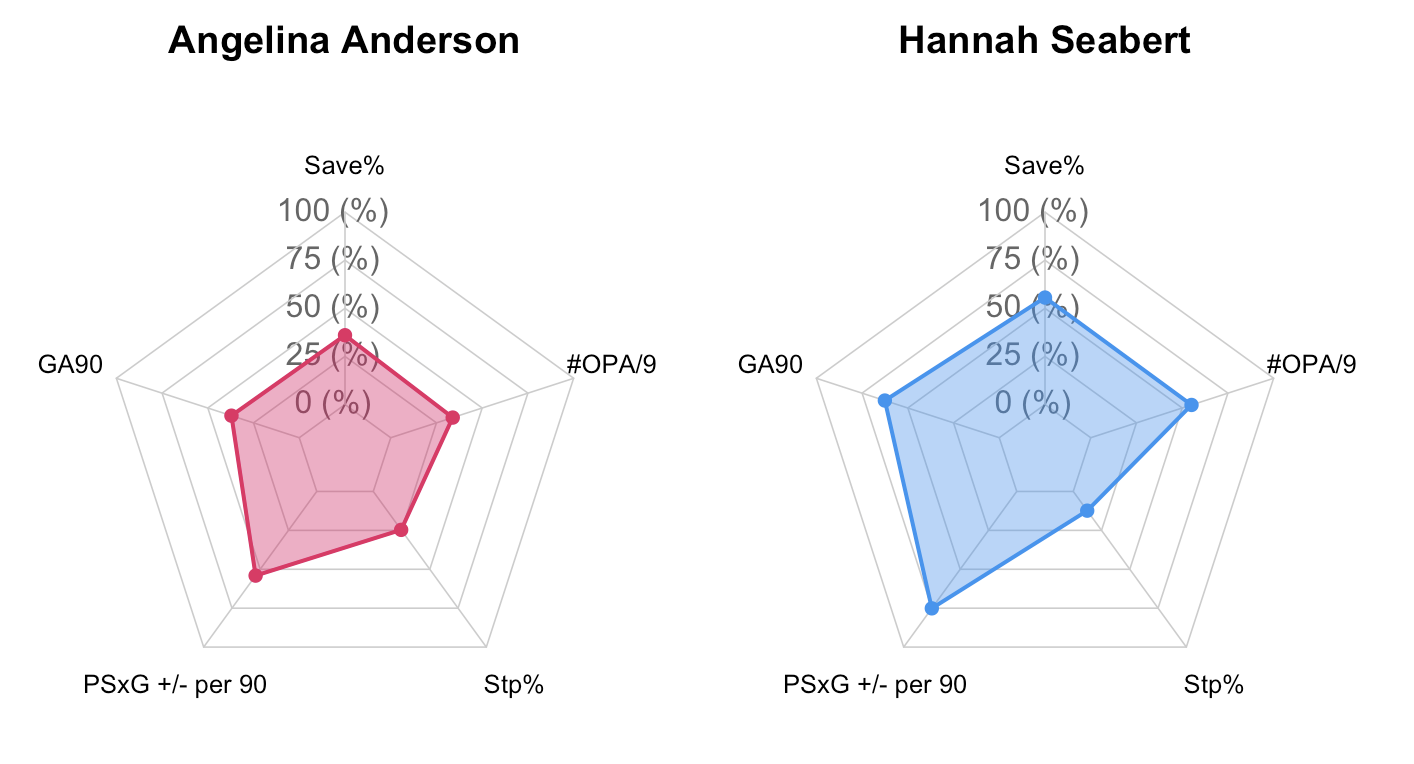
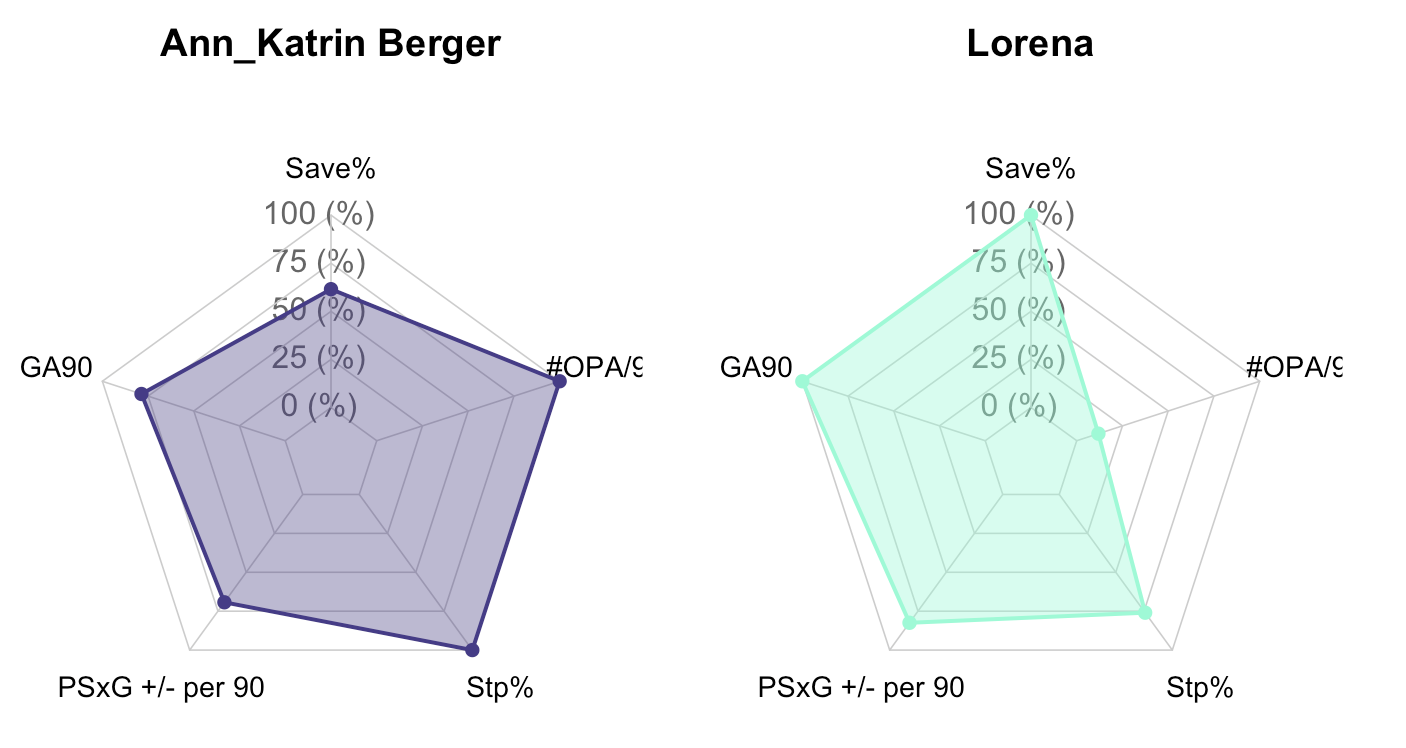
Seabert definitely looks better here, but I also included Ann Katrin Berger and Lorena to get a better view of how some of the best keepers radar plots look. Seabert looks like a good keeper, but not an elite one.
Looking at her individual matches, most of the Goals that Seabert conceded weren’t bad either. The worst was a .08 xG chance to Jaelin Howell from 22 yards out with a PSxG of .22. In every game, Seabert did come up with at least one big stop.
Going into next year, though, I’d have no problem keeping things exactly the same. The major reasoning I have is age. Seabert will be 31 at the start of next season, while Anderson will be 24. Anderson is actually the youngest goalkeeper in the entire NWSL with at least 4 starts. This is her first full season as a starter. I think that Seabert is probably already as good as she’s going to get, and while plenty of goalkeepers play well into their late 30’s, you don’t really see anybody suddenly become elite at that age. Anderson still has the potential to grow more. The major area in which she needs to get better is in the command of her defense. Especially because Angel City does not have a tall, dominant centerback, I think that Anderson needs to take charge in the organization, and come out of goal more often to win aerial balls. The combination of her low percentile in Crosses Stopped, and the number of goals that were scored from close range shows that this is the weakest area of defending. It’s worth reiterating that Seabert was even less likely to stop a cross, so again, I don’t think that she’s a longterm answer. But I would expect that as Anderson gets more experience, her confidence in commanding her box will also grow. So letting Anderson continue to get playing time, with the understanding that Seabert is there to challenge her and will step in if Anderson does falter, isn’t a bad situation to be in. I don’t expect Angel City to sign a new #1 keeper, but I would say that if a situation came up, like Gotham and Berger, where an elite keeper was suddenly available, then we should go for it. But frankly, there are other positions that Angel City should be investing in instead.
Hannah Stambaugh wasn’t mentioned earlier, as she played no competitive minutes, and she has now departed for Boston. She seemed good in the locker room, but this is probably a good move all around. She will be a #2 in Boston, but is likely to see more playing time. Angel City shouldn’t have trouble signing a new #3 keeper for the 2026 season. At a minimum, I think that there are a number of players leaving college that could step into that role.
All stats are from FBRef
And as this will be the last Goosecat article for 2025, thank you very much to all of you for reading and asking questions. It’s always gratifying to hear from you. More to come in 2026!