First Third Analysis, Predictive Models Part I, and Thoughts on Recent ACFC Moves
Before we dive into it, there are just a few items to discuss. Angel City has now played 11 games, and that’s finally enough of a sample size to begin to make some observations with a degree of certainty. But it is only a degree. Also, there is some inclination to call this a midseason break, but it’s important to realize that there are still about 2/3 of Angel City’s 30 regular season games still to play. And finally, Straus’ firing means that this isn’t just an examination of the start of the season, but whether or not Angel City was actually underperforming, and whether he should have been fired, as no other cause was given. But before we really talk about that, let’s look at where Angel City is at this point.
Surface Level Statistics
First and foremost, Angel City is in 12th place with 13 points, and a 4-1-6 record. Because different teams have played a different number of games, though, if we look at points per match, Angel City moves up to 11th with 1.18, leapfrogging Houston. They are 9th in Goals For (16), but this also moves up to 6th in Goals per match (1.45). For Goals Against, ACFC is 8th (14), but that drops to 9th in GA per match (1.27). Putting these together for Goal Difference, Angel City is 8th (+2), which of course means that they are better than four teams above them in the table.
The natural argument is that these are skewed. Every Angel City loss has been by a single goal, while the wins against Chicago and Bay to start the season were a combine 7-1. That is partially why we don’t want to make extrapolations too early in the year, though 11 games should give us a reasonable sample. Strength of schedule is a factor, of course, and Angel City will get to play both Chicago and Bay again in the latter part of the year, as well as both expansion teams. There is some reason to believe that even if those first two games skew the current goal numbers, they are going to be representative of the final season average.
Advanced Statistics
I’ll start with AMA’s g+. Angel City’s Goals Added For is 14.14, good for 7th place between Portland and North Carolina. Goals Added Against is 12.07, 9th place between Denver and Utah. This gives Angel City a Goals Added Differential of +2.07, 7th place. This is a better mark than 5 teams that are above Angel City in the table (Utah, Denver, Seattle, Portland, and Houston).
Hudl has Angel City’s xG For at 14.8 and their xG Against at 14.37 (which is actually the 4th best mark in the league), and has a xG Differential of +0.43, which at least suggests that the actual Goal Differential is not a mirage. Hudl also has Angel City’s Expected Points at 15.6, or 2.6 higher than their actual value, and which would raise them to 10th place. Maybe the most important thing to take from from all of these is that Angel City’s rank in basically every metric is higher than their standing in the table.
Pythagorean Model
A lot of analysts like to come up with a model that delivers that one perfect number, but I’ve never been like that. I like looking at multiple models, because to me, it does give a more complete picture, and provides nuance. However, the downside of that is that you don’t really know how other people are creating their models, and exactly how things are weighted. In essence, it’s a form of the black box problem that factors into many things today, although I completely understand why others want to keep proprietary information to themselves.
So as one more point of context, I’d like to add the Pythagorean predicted points model that I’ve used before, and has a high level of correlation for previous NWSL seasons. It’s a pretty straightforward equation that looks like this:

Where: GF is Goals For, GA is Goals Against, m is the number of matches, and a, b, c, and d are empirical coefficients. Using Clive Beggs’ coefficients: a = 2.78, b = 1.24, c = 1.24, d = 1.25.
As I said, this is very straightforward, and since it uses only goals, it is not taking into account many, many other factors. But my preference is to start with something broader, and work my way inward, rather than begin at the microscopic level. I feel that this does give proper additional context.
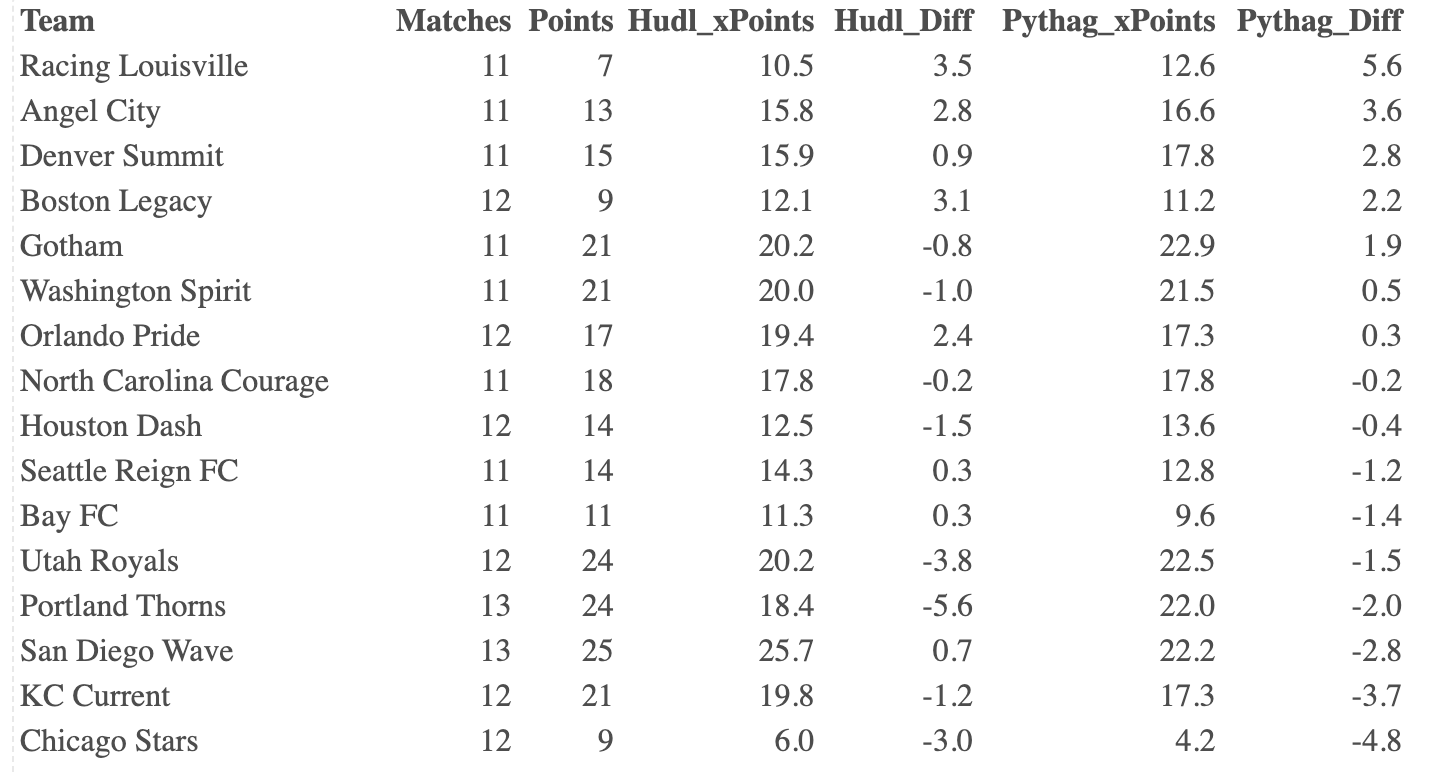
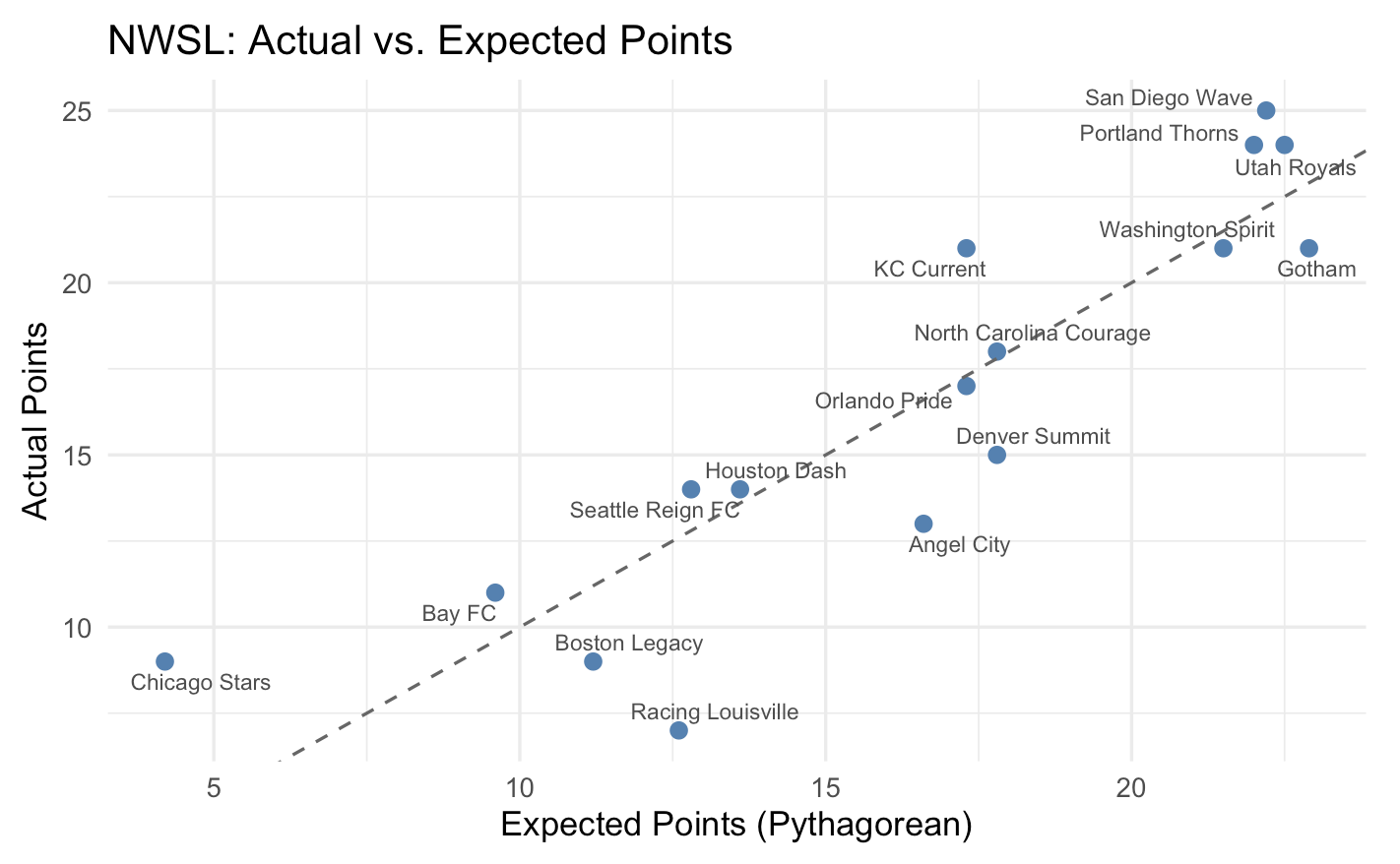
The table above includes both Hudl’s Expected Points, and their difference from actual points, as well as my Pythagorean model. As you can see, Angel City is below what the model expects by 3.6 points, the second highest amount in the league (and third highest on Hudl’s model). And honestly, I don’t think that any of this looks wrong. The Stars are lucky to have 9 points, Washington and Gotham should probably have received a little more, and Louisville is not the worst team in the league. It is conclusive in my mind that Angel City’s record does not accurately reflect the performances.
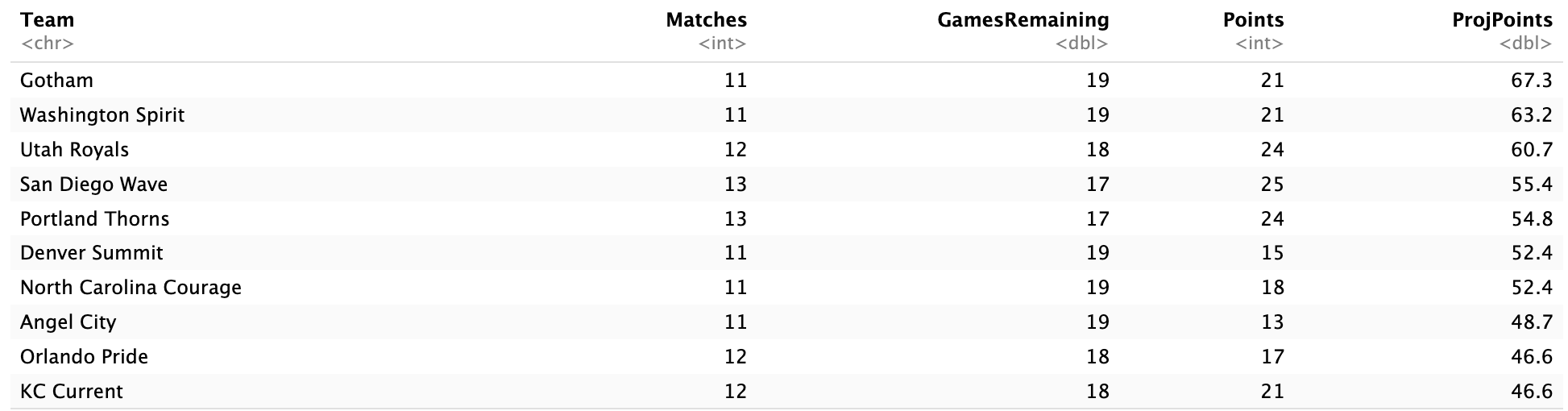
Using this Pythagorean model, I also calculated what the final standings would be, and it did actually predict that Angel City would make the playoffs, based on the trajectory from the first third. The model predicts an 8th place finish, with Orlando and Kansas City just missing out, which I’m sure will cast doubt over these results. I would like to create my own model, though, that is more sensitive to other factors, in order to have more accurate predictions, so please look for that in Part II.
Additional Thoughts Regarding Straus
Mark Parsons spoke at the Season Ticket Holders event over the weekend, and mentioned both that he’d wanted to see more progress from Straus after 12 months, and that after a good first three games, the next eight did not show either the results or performances that were expected. As the models above show, the results do seem particularly harsh, and it also seems likely that more bounces were going to come in the latter part of the season.
Regarding performances, first of all, I thought that even in losses, the performances looked much better than in years past. Secondly, I took it as a positive that other teams were game planning around us, instead of the other way around. Finally, I don’t think that player absences can be discounted. Of those final 8 games, leading offensive producer Jónsdóttir missed four of them. One game featured a red card that put Angel City down a player for more than a half, and against a team that is well set up to sit back and protect a lead in that scenario. That red card also lead to Niehues (tied for the team lead in goals) to be suspended for two games. The injury to Savy King was also a blow that I don’t think has been considered. Angel City was 3-0-1 with her playing this year, and I think that she forms a better centerback partnership with Sams than Gorden does.
This is on top of the losses of Alyssa Thompson last year, and Hina Sugita to injury at the start of this one. I don’t think that Angel City has the depth to lose so many key players and not expect that to be reflected in the results. If Sugita alone were available, my opinion is that would have directly led to three more points, either turning one loss into a win or three losses into draws.
This is also why I consider the 12 month mark to be unfair, especially with losing the team’s best ever player in Alyssa, and not even attempting to replace her. So far this year, Angel City has fielded the youngest team (24.5 years old) in the NWSL, and I think this is also reflective in the results. Many of the issues, such as failing to close out games, can be tied to this inexperience.
Finally, I don’t like the timing of this. Whichever coach comes in will once again not have a preseason, and will have to be thrown straight into a chaotic league season. This was a problem for Straus and it was a problem for Tweed. Even making the decision right before this break could have given a new coach the opportunity to get to know the players without the challenges of preparing for matches. And finally, I think that it’s a concern to fire a coach for a bad run of eight games. Pretty much every team in the NWSL will have a stretch like that over the course of a season, and I don’t think that we will ever build a championship team if the coach is fired every year. We’ll see who is brought in, but to my knowledge, there really isn’t any coach currently available that has the resume that Straus did.
Obviously, things are going to look different inside the club, and I’m sure that there is additional information about this decision that I’m not aware of or privy to. But I think that from the outside, all of the evidence is that this was a very harsh firing. I would have had every expectation, based on the underlying statistics, that Angel City’s position on the table would improve. It’s hard to see this decision as anything other than pulling the plug on the season, especially with losing Fuller as well. It is entirely possible that someone will step in, and put together a string of results by playing a very pragmatic style to get Angel City to the playoffs, like Becki Tweed did. But I would then be worried that it’s difficult to build off that, as also happened with Tweed. We’ll have to see what happens.
Data was collected from Wyscout, FBRef, and the NWSL.